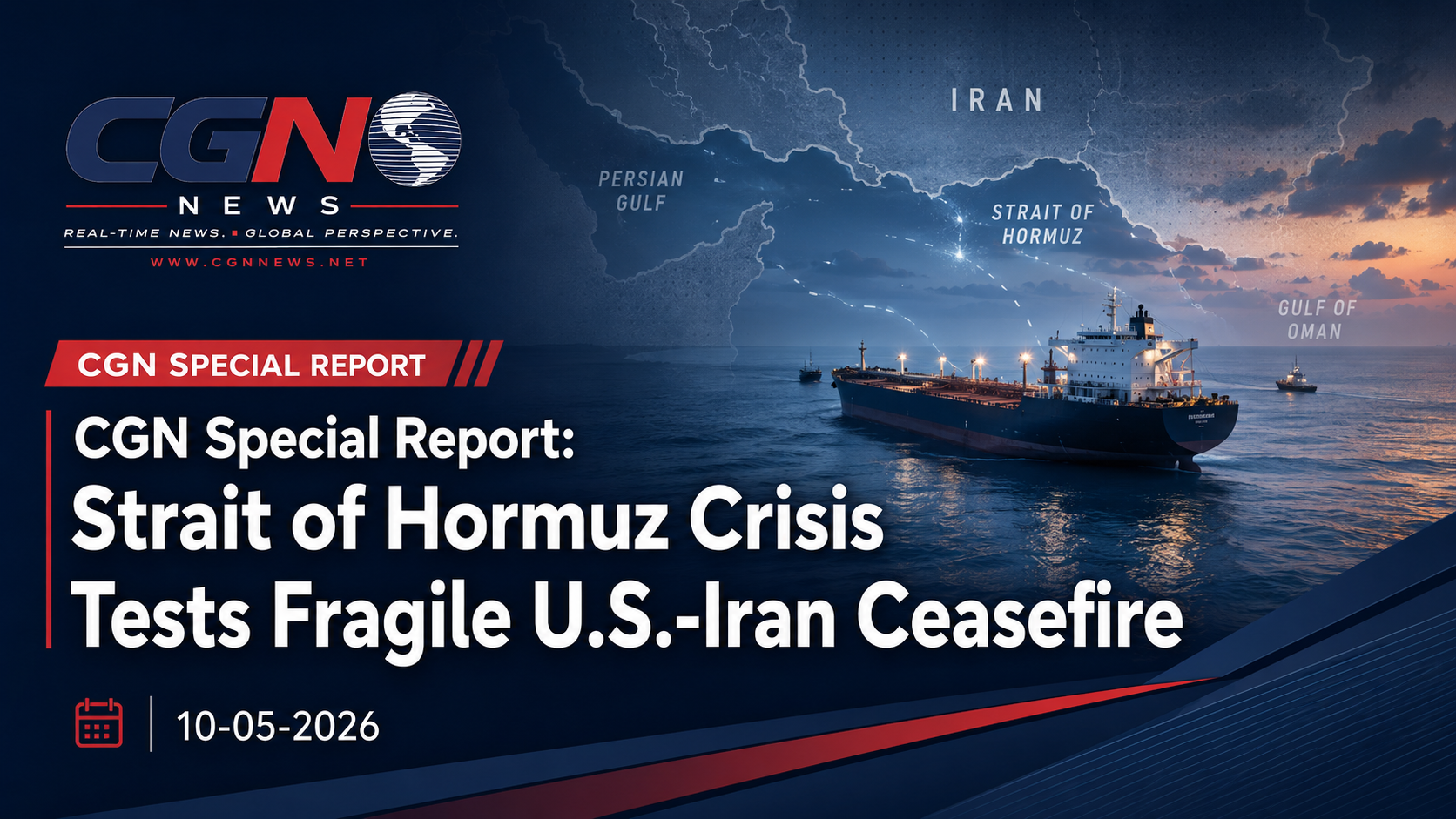
LONDON | The fragile U.S.-Iran ceasefire is being tested at the Strait of Hormuz, where military warnings, shipping risk, oil-market pressure and unresolved nuclear questions have turned one narrow waterway into the most important flashpoint in the global economy.
The crisis is not only about whether another round of open fighting begins. It is about how many things can go wrong before one incident becomes a wider war: a drone near a ship, a cargo fire in the Gulf, a warning from Tehran, a U.S. naval movement, a misread radar contact or a sudden jump in crude prices that spills into inflation at home.
The Independent has tracked the latest war and ceasefire developments, including warnings around the Strait of Hormuz and renewed pressure on the Trump administration as the U.S. and Iran test the limits of a temporary pause. The Associated Press separately reported on a ceasefire under strain after drone incidents and a cargo-ship fire near Qatar, placing the Gulf at the center of a tense diplomatic and military standoff. Associated Press
The Strait of Hormuz is the pressure valve. A major share of seaborne oil moves through the passage, and markets treat any threat there as more than a regional security problem. Energy traders react first, then shipping insurers, airlines, trucking firms, central banks and households that eventually see risk translated into fuel prices.
That is why the ceasefire is fragile even when guns are quiet. Washington wants to deter Iran, protect shipping and avoid an energy shock. Tehran wants leverage over the waterway, sanctions pressure and nuclear negotiations. Gulf states want stability without becoming the battlefield. Every player has an incentive to avoid all-out war, but each also has an incentive to test the other side.
The Guardian reported that neither the United States nor Iran can sustain a Strait of Hormuz standoff indefinitely. That is the center of the strategic math. The costs build quickly. Oil rises. Ships reroute or pause. Military escorts increase. Domestic politics harden. A ceasefire that should lower risk can become another stage for pressure if both sides treat restraint as weakness.
The Federal Reserve’s May 2026 Financial Stability Report shows why the conflict now reaches beyond diplomats and generals. Surveyed market contacts cited geopolitical risks and an oil shock among the top threats to financial stability. When the Fed frames an oil shock as a financial-stability concern, the Gulf crisis becomes a pocketbook issue for Americans as well as a security issue for commanders.
President Donald Trump faces that dual challenge. A hard line against Iran can be sold as strength, but a prolonged energy shock can punish consumers and investors. A ceasefire can be presented as control, but a failed ceasefire can make the administration appear trapped between escalation and retreat.
For Iran, the same dilemma runs in reverse. The Strait offers leverage, but leverage is dangerous when it relies on threatening a global commodity corridor. Iran can show that it cannot be isolated without consequence, but the longer the pressure continues, the greater the risk of military overreach, economic strain and diplomatic isolation.
The nuclear issue makes compromise harder. Any settlement that reduces immediate fighting but leaves the nuclear program unresolved may be viewed by Washington, Israel and Gulf allies as temporary. Iran, meanwhile, is unlikely to surrender leverage without concrete relief from sanctions or security pressure.
That leaves the region in a dangerous middle ground. It is not peace, and it is not full war. It is a contest over boundaries: what counts as a ceasefire violation, what can be blamed on confusion, what can be attributed to proxies, and what kind of military movement requires a response.
The most dangerous incidents are often the ambiguous ones. A drone over water, a ship fire, a cyber disruption or a warning shot can be interpreted differently by each side. In a region where naval forces, commercial shipping, air defenses and proxy networks operate close together, ambiguity can become escalation.
Oil markets are watching for physical signals more than speeches. Are ships moving through the Strait with confidence? Are insurers repricing risk? Are escorts increasing? Are Gulf ports operating normally? Those details may matter more than official statements because markets often move before diplomacy does.
The domestic economic channel is equally important. If crude prices remain elevated, inflation expectations can shift, interest-rate cuts can move further away, and consumer confidence can weaken. A war thousands of miles away can change the cost of commuting, flying, shipping and feeding a household.
The ceasefire therefore rests on more than military restraint. It depends on whether the United States and Iran can create enough predictability for shippers, insurers and regional governments to believe the waterway is usable. Without that confidence, the crisis continues even if the ceasefire technically holds.
The next markers are clear: official language from Washington and Tehran, IAEA nuclear statements, Gulf air-defense alerts, shipping advisories, oil-price movement, and any confirmed drone or maritime incident. Each will be read as evidence of whether the ceasefire is stabilizing or fraying.
For now, the Strait of Hormuz is where the world’s military anxiety, energy dependency and inflation fears meet. A ceasefire may be in place, but the Gulf is still telling markets and governments that the crisis has not ended.
The deeper story is how the Strait of Hormuz crisis moves from a headline into decisions made by families, companies, public officials and markets. The visible event is only the front door. Behind it are systems of money, policy, logistics, public trust and institutional judgment that determine whether the moment becomes temporary noise or something with lasting consequences.
The ceasefire question matters because it forces readers to look beyond the first facts and ask what kind of pressure is building. A single development can reveal whether an institution is prepared, whether leaders are communicating honestly and whether ordinary people have enough information to understand how the issue affects them.
For Washington, Tehran, Gulf governments and energy-market regulators, the challenge is credibility. Public institutions and major organizations do not earn trust by issuing broad assurances. They earn it by giving clear explanations, making records available, acknowledging uncertainty and correcting course when facts change. In fast-moving stories, that kind of disciplined communication can be as important as the underlying decision.
For drivers, shippers, investors and military families, the issue is practical. People want to know what changed, what is known, what remains uncertain and what they should watch next. Good reporting should not bury that under jargon. It should translate complex developments into plain language without oversimplifying the stakes.
The financial dimension is also important. oil-market pressure and the possibility of another inflation shock can change incentives quickly. When costs rise, risks spread or funding flows into a system, the people closest to the impact often feel the pressure before policymakers or executives finish explaining it.
The public should also pay attention to timing. Events that happen near elections, earnings reports, court deadlines, policy votes or travel seasons can carry more weight than the same facts would carry in a quieter period. Timing can determine whether a story stays local, becomes national or moves markets.
Another layer is accountability. The strongest public-interest stories are not built around shock alone. They are built around records, public consequences and the question of whether people with power are being honest about what they know. That standard matters whether the subject is government, business, health, sports, energy or entertainment.
The local effect of a global waterway is felt at fuel pumps, in shipping costs and in central-bank decisions also shapes the impact. A national story can land differently in Indiana, Chicago, Washington, London or a small local community. Readers need both the wider context and the human-level effect, because large systems are experienced through specific prices, services, votes, games, jobs, warnings and public decisions.
The first thing to watch is whether the official record grows clearer. Public statements, court filings, financial disclosures, health guidance, market data and agency reports can either confirm the direction of a story or force a rewrite of early assumptions. That is why source discipline matters.
The second thing to watch is whether the people affected have meaningful recourse. Information is useful only if it helps someone make a decision, protect a household, judge a leader, understand a market, plan travel, follow a team or participate in civic life.
The third thing to watch is whether the story produces a policy response or simply fades. Many public problems survive because attention moves on before systems change. The lasting question is whether this moment becomes evidence for reform, enforcement, investment or better oversight.
Public trust is fragile in these moments. People know when a story is being padded, spun or softened. They also know when reporting is clear about what is confirmed and careful about what is not. A strong public-facing account should be direct without being reckless.
That is especially true when the subject involves public money, health risk, courts, elections, security, markets or public safety. In those areas, even small errors can damage trust. The goal is not drama for its own sake. The goal is useful accountability.
The most important facts are often the least flashy. Dates, filings, official statements, score lines, dollar amounts, court actions, agency guidance and market data create the structure readers can rely on. Interpretation should sit on top of that structure, not replace it.
Careful language about the ceasefire does not weaken the story. It strengthens it. Readers can handle uncertainty when it is explained clearly. What they cannot trust is certainty that outruns the record.
The broader pattern is that modern news rarely fits one category. Business stories affect politics. Health stories affect travel and local services. Energy stories affect inflation. Technology stories affect privacy and work. Sports stories affect civic identity and economic activity. The connections are the point.
For CGN News readers, the value is not only knowing what happened. It is understanding why the event belongs in a larger public conversation. The best reporting connects the immediate fact to the system behind it and the choices ahead.
Ship movements, oil prices, IAEA language, military alerts and White House statements will determine whether this story grows, stabilizes or fades. Until then, the responsible approach is to follow the records, keep the language precise and focus on the consequences for the people and institutions most affected.
Seen through energy security and foreign policy, the Strait of Hormuz crisis also shows how quickly a single news event can expose older tensions that were already present. The headline may be new, but the pressures beneath it often involve years of policy choices, market behavior, institutional habits and public frustration.
That is why the story should not be read as isolated. oil shock risk, ceasefire uncertainty and nuclear diplomacy is part of a broader pattern in which public systems are asked to operate under more stress, with less margin for error and more scrutiny from people who expect answers in real time.
The public record gives the story its foundation. official ceasefire statements, AP reporting, market signals and the Fed’s financial-stability report help separate what is known from what is still developing. That distinction is not cosmetic. It is what allows readers to trust the article without feeling that the reporting is trying to push them faster than the facts allow.
For households, shippers, investors and policymakers, the practical question is what changes next. A story can be important because it changes law, money, travel, safety, local services, public health, political representation or how people understand the institutions around them.
The human effect is often quieter than the official action. A lawsuit, market report, court ruling, health alert or sports result may begin as a formal update. Its real impact is felt when a family changes plans, a worker faces uncertainty, a voter loses confidence, an investor rethinks risk or a patient looks for care.
That is why context belongs inside the article, not outside it. Readers should not have to know the background before they arrive. A strong public-facing story gives them the facts, the stakes, the timeline and the reason the subject matters now.
Pressure also tends to reveal weak points. A market shock exposes leverage. A health emergency exposes preparedness. A redistricting fight exposes legal assumptions. A nonprofit lawsuit exposes governance. A technology story exposes privacy or accountability gaps. A sports opener exposes roster strengths and weaknesses before the season narrative hardens.
Institutions often respond slowly because they are built for process. The public responds quickly because people need to make decisions. That gap is where confusion grows. Good reporting helps close it by making the available information clear without pretending that every answer is already known.
The most useful next step is transparency. When officials, companies, leagues, courts or agencies provide clear records and explanations, public confidence improves even when the news is uncomfortable. When they speak vaguely or delay, suspicion fills the space.
Readers should also watch whether the incentives change. Money, votes, ratings, energy prices, legal liability, staffing shortages and public pressure all shape what institutions do after the headline fades. The follow-through often matters more than the announcement.
CGN News is treating this story as part of a wider public-interest record: what happened, who is affected, what the documents or official sources show, and what consequences could follow. That approach keeps the focus on accountability rather than spectacle.
The clearest measure of importance is whether the story helps readers understand power. Who has it, who is using it, who is paying for it, who is affected by it and what evidence supports the public claims being made. That is the test this story meets.
Additional Reporting By: The Independent; Associated Press; The Guardian; Federal Reserve.