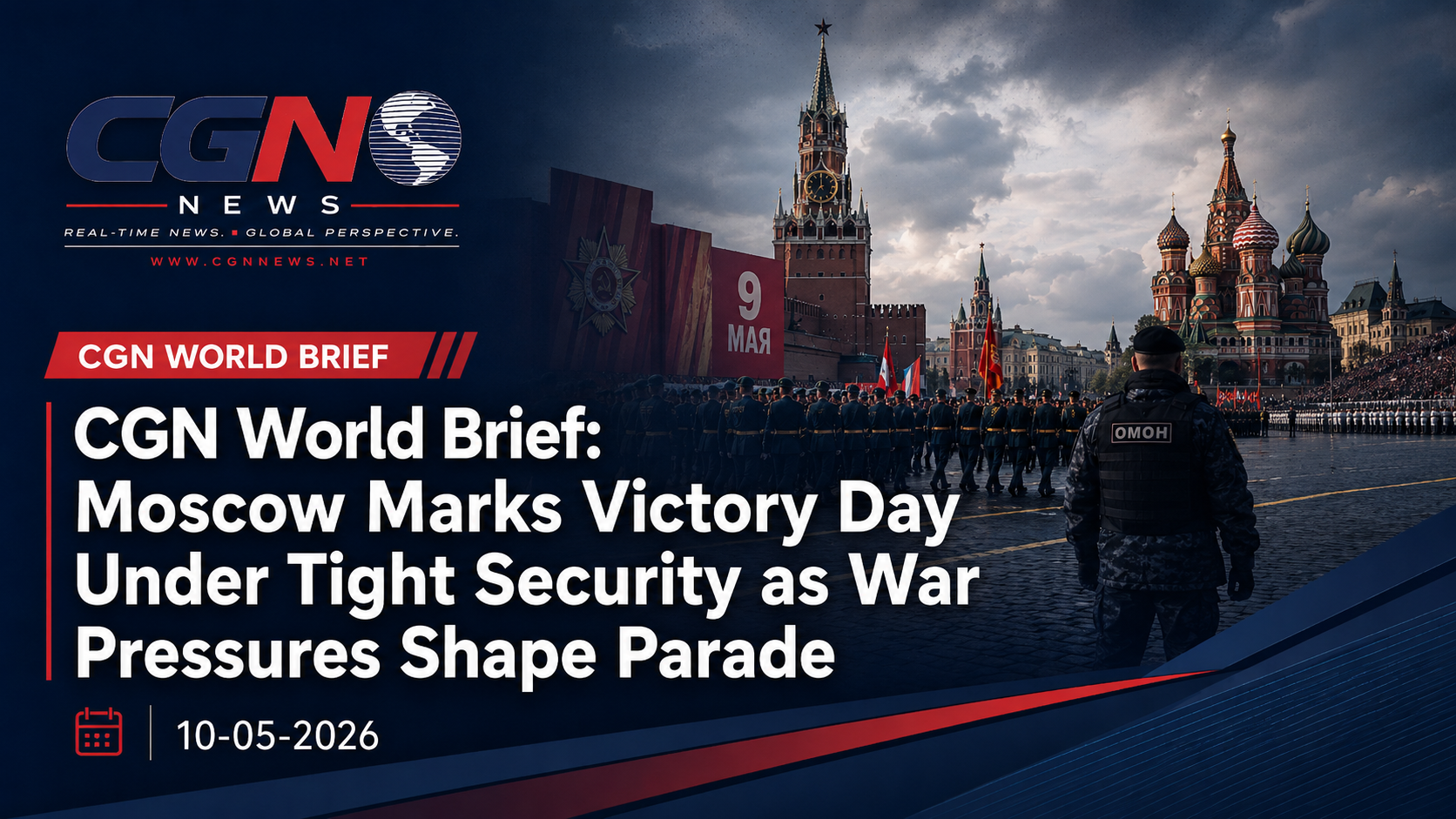
LONDON | Russia marked Victory Day in Moscow with a scaled-down Red Square parade under tight security, a ceremony designed to project endurance even as the war in Ukraine continues to shape the country’s politics, military posture and public narrative.
Associated Press reported that President Vladimir Putin said the conflict in Ukraine was nearing its end as he oversaw a parade that, notably, did not include heavy weapons for the first time in nearly two decades.
The symbolism was impossible to miss. Victory Day has long been one of the Kremlin’s most important patriotic rituals, linking the Soviet defeat of Nazi Germany to contemporary Russian identity. This year, the show of strength was more restrained, reflecting the security pressures and battlefield realities that now surround Moscow’s wartime messaging.
The Guardian described the parade as scaled back, with heightened security measures and the absence of some traditional displays of heavy military equipment. The reduced display did not weaken the Kremlin’s message. It changed the form of the message: confidence, sacrifice and wartime patience rather than unchallenged power.
Putin’s remarks served two audiences. At home, he framed Russia’s war effort as historically inevitable and morally continuous with the memory of World War II. Abroad, he signaled that Moscow does not intend to accept Ukrainian or Western terms that would be seen in the Kremlin as defeat.
The absence of heavy weapons matters because Victory Day parades are normally choreographed showcases. Tanks, missiles and armored vehicles are not only equipment; they are political theater. Their reduced presence raises practical and symbolic questions about security, battlefield demand and how much of Russia’s available military power is better kept away from the parade route.
The security environment has changed sharply since Russia’s full-scale invasion of Ukraine. Drone threats, sabotage concerns and domestic anxiety have forced public ceremonies to become more managed. Moscow can still stage grandeur, but it must now do so inside a tighter perimeter.
That tension made the parade a useful snapshot of wartime Russia. The Kremlin continues to claim confidence. It continues to use history as a mobilizing language. It continues to present Ukraine and the West as obstacles to a Russian destiny. But the public form of that message has become more defensive.
For Ukraine, the parade was another reminder that Moscow is not signaling readiness for a settlement on Kyiv’s terms. Even when Putin suggests the conflict may be nearing an end, he does not define that end as withdrawal or compromise. Russian language around victory tends to mean endurance until the other side accepts Moscow’s demands.
For Europe, the parade underscored the long-term nature of the security challenge. A Russia that can scale down a parade while continuing the war is not necessarily a Russia preparing to stop. It may be a Russia conserving resources, tightening security and adjusting propaganda to a conflict that has lasted longer than many expected.
The event also showed how memory politics remains central to Moscow’s war case. Victory Day allows the Kremlin to cast current conflicts through the moral authority of World War II. Critics argue that this framing collapses historical memory into political justification. Supporters inside Russia see it as continuity, sacrifice and national survival.
The parade’s timing, during a ceasefire window and amid persistent battlefield uncertainty, made the choreography more than ceremonial. It showed a government trying to project control over a war that has strained its economy, military and public patience.
Internationally, Russia’s ability to draw foreign attendance or military symbolism into the parade remains part of its effort to show it is not isolated. At the same time, the heavy security and reduced display reveal the limits of that projection.
The key question after the parade is whether Moscow’s confidence reflects military momentum, diplomatic positioning or domestic messaging. Those are different things. A strong speech does not necessarily mean a strong battlefield position. A smaller parade does not necessarily mean weakness. Together, they show a state trying to balance image and constraint.
For ordinary Russians, the event likely carried both pride and fatigue. Victory Day remains emotionally powerful across generations. But the war has brought casualties, inflation, mobilization fears and pressure on families. Public ceremony can unify, but it cannot erase private cost.
Putin’s message that the conflict is nearing an end will be watched closely. If Moscow follows the parade with more hard-line demands, the statement may prove rhetorical. If it is followed by diplomatic movement, it could become meaningful. For now, it is best read as part of Russia’s broader effort to define the war’s conclusion before negotiations do.
The scaled-down parade did not diminish the political importance of Victory Day. It revealed how the war has changed even Russia’s most scripted displays of strength. Moscow still wants to be seen as victorious. The question is how much longer it can sustain that image while the war keeps demanding proof.
The deeper story is how Russia’s Victory Day parade moves from a headline into decisions made by families, companies, public officials and markets. The visible event is only the front door. Behind it are systems of money, policy, logistics, public trust and institutional judgment that determine whether the moment becomes temporary noise or something with lasting consequences.
The scaled-down ceremony matters because it forces readers to look beyond the first facts and ask what kind of pressure is building. A single development can reveal whether an institution is prepared, whether leaders are communicating honestly and whether ordinary people have enough information to understand how the issue affects them.
For the Kremlin, European governments and NATO planners, the challenge is credibility. Public institutions and major organizations do not earn trust by issuing broad assurances. They earn it by giving clear explanations, making records available, acknowledging uncertainty and correcting course when facts change. In fast-moving stories, that kind of disciplined communication can be as important as the underlying decision.
For Russian citizens, Ukrainian families and European voters, the issue is practical. People want to know what changed, what is known, what remains uncertain and what they should watch next. Good reporting should not bury that under jargon. It should translate complex developments into plain language without oversimplifying the stakes.
The financial dimension is also important. the cost of a long war, sanctions pressure and battlefield uncertainty can change incentives quickly. When costs rise, risks spread or funding flows into a system, the people closest to the impact often feel the pressure before policymakers or executives finish explaining it.
The public should also pay attention to timing. Events that happen near elections, earnings reports, court deadlines, policy votes or travel seasons can carry more weight than the same facts would carry in a quieter period. Timing can determine whether a story stays local, becomes national or moves markets.
Another layer is accountability. The strongest public-interest stories are not built around shock alone. They are built around records, public consequences and the question of whether people with power are being honest about what they know. That standard matters whether the subject is government, business, health, sports, energy or entertainment.
A Moscow parade becomes a European security signal also shapes the impact. A national story can land differently in Indiana, Chicago, Washington, London or a small local community. Readers need both the wider context and the human-level effect, because large systems are experienced through specific prices, services, votes, games, jobs, warnings and public decisions.
The first thing to watch is whether the official record grows clearer. Public statements, court filings, financial disclosures, health guidance, market data and agency reports can either confirm the direction of a story or force a rewrite of early assumptions. That is why source discipline matters.
The second thing to watch is whether the people affected have meaningful recourse. Information is useful only if it helps someone make a decision, protect a household, judge a leader, understand a market, plan travel, follow a team or participate in civic life.
The third thing to watch is whether the story produces a policy response or simply fades. Many public problems survive because attention moves on before systems change. The lasting question is whether this moment becomes evidence for reform, enforcement, investment or better oversight.
Public trust is fragile in these moments. People know when a story is being padded, spun or softened. They also know when reporting is clear about what is confirmed and careful about what is not. A strong public-facing account should be direct without being reckless.
That is especially true when the subject involves public money, health risk, courts, elections, security, markets or public safety. In those areas, even small errors can damage trust. The goal is not drama for its own sake. The goal is useful accountability.
The most important facts are often the least flashy. Dates, filings, official statements, score lines, dollar amounts, court actions, agency guidance and market data create the structure readers can rely on. Interpretation should sit on top of that structure, not replace it.
Caution about reading ceremony as either weakness or strength does not weaken the story. It strengthens it. Readers can handle uncertainty when it is explained clearly. What they cannot trust is certainty that outruns the record.
The broader pattern is that modern news rarely fits one category. Business stories affect politics. Health stories affect travel and local services. Energy stories affect inflation. Technology stories affect privacy and work. Sports stories affect civic identity and economic activity. The connections are the point.
For CGN News readers, the value is not only knowing what happened. It is understanding why the event belongs in a larger public conversation. The best reporting connects the immediate fact to the system behind it and the choices ahead.
Russian military movements, ceasefire statements, battlefield reports and diplomatic signals will determine whether this story grows, stabilizes or fades. Until then, the responsible approach is to follow the records, keep the language precise and focus on the consequences for the people and institutions most affected.
Seen through war politics, Russia’s scaled-down Victory Day parade also shows how quickly a single news event can expose older tensions that were already present. The headline may be new, but the pressures beneath it often involve years of policy choices, market behavior, institutional habits and public frustration.
That is why the story should not be read as isolated. security constraints, battlefield pressure and propaganda messaging is part of a broader pattern in which public systems are asked to operate under more stress, with less margin for error and more scrutiny from people who expect answers in real time.
The public record gives the story its foundation. AP reporting, parade imagery, security measures and official statements help separate what is known from what is still developing. That distinction is not cosmetic. It is what allows readers to trust the article without feeling that the reporting is trying to push them faster than the facts allow.
For European governments, Ukrainian families and Russian citizens, the practical question is what changes next. A story can be important because it changes law, money, travel, safety, local services, public health, political representation or how people understand the institutions around them.
The human effect is often quieter than the official action. A lawsuit, market report, court ruling, health alert or sports result may begin as a formal update. Its real impact is felt when a family changes plans, a worker faces uncertainty, a voter loses confidence, an investor rethinks risk or a patient looks for care.
That is why context belongs inside the article, not outside it. Readers should not have to know the background before they arrive. A strong public-facing story gives them the facts, the stakes, the timeline and the reason the subject matters now.
Pressure also tends to reveal weak points. A market shock exposes leverage. A health emergency exposes preparedness. A redistricting fight exposes legal assumptions. A nonprofit lawsuit exposes governance. A technology story exposes privacy or accountability gaps. A sports opener exposes roster strengths and weaknesses before the season narrative hardens.
Institutions often respond slowly because they are built for process. The public responds quickly because people need to make decisions. That gap is where confusion grows. Good reporting helps close it by making the available information clear without pretending that every answer is already known.
The most useful next step is transparency. When officials, companies, leagues, courts or agencies provide clear records and explanations, public confidence improves even when the news is uncomfortable. When they speak vaguely or delay, suspicion fills the space.
Readers should also watch whether the incentives change. Money, votes, ratings, energy prices, legal liability, staffing shortages and public pressure all shape what institutions do after the headline fades. The follow-through often matters more than the announcement.
CGN News is treating this story as part of a wider public-interest record: what happened, who is affected, what the documents or official sources show, and what consequences could follow. That approach keeps the focus on accountability rather than spectacle.
The clearest measure of importance is whether the story helps readers understand power. Who has it, who is using it, who is paying for it, who is affected by it and what evidence supports the public claims being made. That is the test this story meets.
Additional Reporting By: Associated Press; The Guardian.