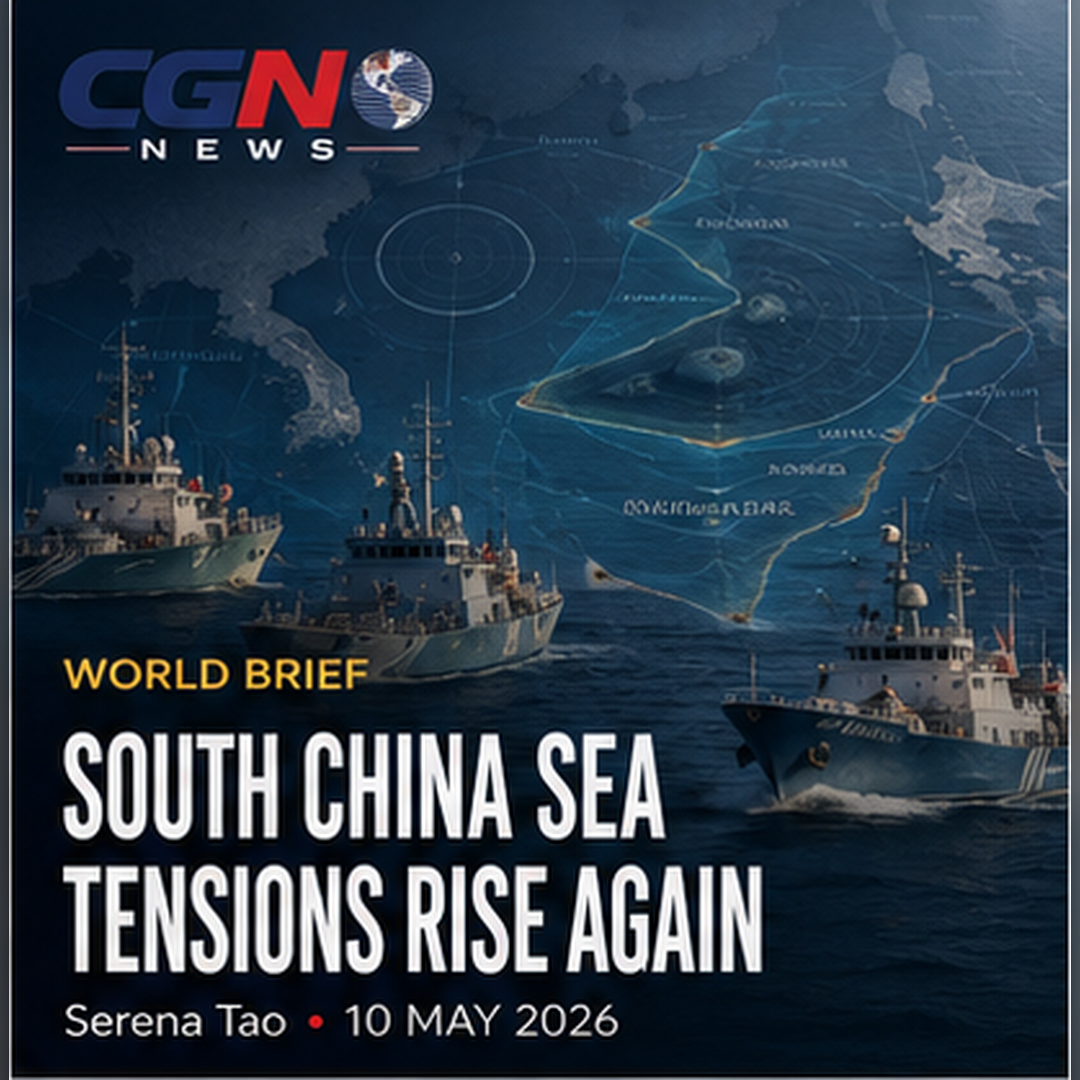
HONG KONG — A disputed sandbar in the South China Sea has again become a measure of the region’s larger security problem: small encounters are carrying strategic weight, and neither Beijing nor Manila appears willing to treat them as minor. China accused the Philippines of landing personnel on Sandy Cay, while Manila said it would dispatch ships to drive off Chinese vessels it said were conducting illegal research near the feature. The exchange, reported by Reuters, placed a tiny reef system inside the Spratly Islands back in the middle of a confrontation that now regularly involves coast guards, military drills, legal arguments and U.S. alliance commitments.
Sandy Cay is not large, but its importance is larger than its geography. It lies near Thitu Island, the largest Philippine-held feature in the Spratlys, and within an area where China’s coast guard, maritime militia and state-linked vessels have repeatedly challenged Philippine activity. For Manila, allowing Chinese personnel or research teams to operate freely around the feature risks normalizing Beijing’s presence. For Beijing, any Philippine landing or patrol is framed as a violation of Chinese sovereignty claims. That means each side sees the other’s routine move as a precedent.
Reuters reported that China’s coast guard said it had identified five Philippine personnel who landed on Sandy Cay, an action Beijing described as illegal. Manila, meanwhile, said it had acted after Chinese state media showed Chinese coast guard personnel on Sandy Cay holding a Chinese flag. The symbolism matters. In disputed maritime areas, flags, photos, landings and patrol announcements are not simply messaging. They become evidence used in domestic politics, legal arguments and future operational behavior. A sandbar that may be submerged or exposed depending on tides can still become a stage for competing national claims.
The confrontation comes as the Philippines deepens defense cooperation with allies and partners. Reuters reported last week that Japan fired an anti-ship missile during a joint drill with the United States, Australia and the Philippines in northern Philippine waters facing the South China Sea. Associated Press reported that Japan and the Philippines agreed to begin talks on a weapons transfer pact amid concern over China’s coercive activity. Together, those developments show how the South China Sea dispute is no longer only a bilateral argument between Manila and Beijing. It has become part of a wider Indo-Pacific security network.
For President Ferdinand Marcos Jr.’s government, the South China Sea is both a sovereignty issue and a domestic political test. Philippine fishermen, coast guard crews and local communities have become central to the country’s maritime narrative. When Chinese vessels appear near reefs or shoals claimed by Manila, the government faces pressure to respond visibly. That pressure has increased as videos of water-cannon incidents, close approaches and blockades have circulated widely. The state’s credibility is tied to whether it can protect access without triggering open conflict.
China’s calculus is different but equally political. Beijing claims sovereignty over much of the South China Sea and has rejected the 2016 arbitral ruling that found no legal basis for its sweeping historic-rights claims in waters also claimed by other states. China’s coast guard has become the main instrument of pressure, operating in a gray zone below conventional naval combat but above ordinary law enforcement. The advantage of that approach is flexibility. The risk is that routine pressure can produce accidents, collisions or misread signals that pull governments into a crisis they did not intend.
The United States sits behind the confrontation even when it is not physically present. Washington has repeatedly said that its mutual defense treaty with the Philippines applies to armed attacks on Philippine armed forces, public vessels or aircraft in the South China Sea. That assurance is designed to deter escalation. It also raises the stakes of every confrontation involving Philippine coast guard vessels or military personnel. A collision, injury or deliberate attack could quickly become a treaty question.
The latest Sandy Cay exchange also unfolded in a region worried about energy security because of the war around Iran and the Strait of Hormuz. Reuters reported that Southeast Asian leaders at an ASEAN summit in Cebu pushed to fast-track a regional oil-sharing framework in response to Middle East disruptions. That same summit also addressed maritime security, with the Philippines proposing an ASEAN maritime center while avoiding language that directly targeted China. The overlap is important: maritime security in Asia is not only about sovereignty. It is also about trade routes, fuel supply and crisis coordination.
ASEAN remains limited by consensus politics. Several members have strong economic ties to China, while others face direct maritime pressure. That makes a unified response difficult. Even when leaders agree on freedom of navigation or energy resilience, implementation can be slow and cautious. The proposed maritime center may help share information and coordinate responses, but it will not remove the central dispute over sovereignty, fishing rights, resource access and coast guard behavior.
Serena Tao’s view from the region is that Sandy Cay should be understood as a warning light rather than an isolated event. The feature is small enough that outsiders may overlook it, but repeated encounters around small features can reshape the practical status quo. If one side patrols more often, lands personnel, plants flags, conducts research or blocks the other’s vessels, the daily reality at sea changes before any legal claim changes on paper. That is how gray-zone pressure works: it creates new facts gradually.
The danger for Manila is that a failure to respond could be read as acceptance. The danger for Beijing is that a more forceful response could accelerate the very coalition-building it opposes. Japan’s expanding defense role, U.S.-Philippine military exercises and Australia’s participation in regional drills all reflect concern that China’s tactics are pushing neighbors closer together. Every incident around Sandy Cay therefore carries a second-order consequence: it affects the pace and shape of regional military alignment.
Markets and commercial shippers are not ignoring the dispute either. The South China Sea is one of the world’s most important maritime corridors, carrying energy, manufactured goods and raw materials across Asia. A major military conflict remains unlikely in the immediate term, but persistent low-level confrontation raises insurance, planning and strategic risk. Companies may not reroute because of one incident near Sandy Cay, but they do watch the pattern. A region that appears less predictable becomes more expensive to plan around.
The next signs to watch are operational rather than rhetorical. Does Manila send coast guard or navy assets to the area, and does China shadow or block them? Do Chinese vessels return with research equipment or symbolic displays? Does either side release images intended to prove presence? Do U.S. or Japanese officials issue public support statements? Those are the signals that will show whether the incident is being contained or folded into a larger pressure campaign.
For now, Sandy Cay remains a small place with large consequences. Its latest dispute shows how regional tensions are built not only through summits and war games, but through contested landings, patrols and flags on features many people will never see. In the South China Sea, geography is politics, and politics often arrives in the form of a coast guard vessel on the horizon.
Historical memory shapes the confrontation. Philippine officials frequently point to the 2016 arbitral ruling under the United Nations Convention on the Law of the Sea, while China continues to reject that ruling and asserts its own claims. That legal divide means the parties are often arguing from incompatible starting points. One side sees enforcement of maritime rights; the other sees provocation inside territory it claims. Because the underlying legal dispute is unresolved in practice, each operational encounter becomes another attempt to strengthen a claim.
Technology is changing the dispute as well. Satellite images, ship-tracking data, mobile video and state-media posts can turn a brief encounter into an international incident within hours. Governments now use images not only to inform the public, but to create a record. A photograph of a flag, a video of a vessel’s course or a claim about research activity can be used later to justify more patrols. The information space has become part of the maritime battlefield.
The Philippines has tried to internationalize the issue by sharing more evidence publicly and inviting partners into exercises. That strategy raises the cost of Chinese pressure by making incidents harder to dismiss as obscure local disputes. But it also carries risks. Beijing may respond by increasing its own patrols or accusing Manila of acting as a proxy for Washington. The more outside powers appear in the dispute, the harder it becomes to keep a single incident from becoming a larger diplomatic confrontation.
China, for its part, benefits from persistence. It does not need to seize every feature by force if repeated patrols, symbolic landings and administrative claims gradually change expectations. That is why the tempo of activity matters. Even actions that fall short of combat can have strategic effect if they become routine. Manila’s challenge is to respond without creating the escalation Beijing says it is trying to avoid.
Regional governments are watching because the pattern may apply elsewhere. Vietnam, Malaysia, Brunei and Taiwan all have interests in the South China Sea, even if their current disputes with China differ from the Philippine case. If Sandy Cay becomes an example of how maritime pressure is managed or resisted, other claimants will draw lessons. That is one reason ASEAN discussions move carefully: members disagree not only over China, but over how much confrontation they can afford.
The U.S. alliance with the Philippines will remain the background condition. Washington does not need to lead every patrol for its presence to matter. Its treaty commitments influence how Beijing calculates risk and how Manila calculates confidence. That does not make conflict inevitable. It does mean a collision involving government vessels could quickly become a question for alliance managers, not only coast guard commanders.
Another issue is the role of research activity. Manila’s claim that Chinese vessels were conducting research illegally points to a recurring fear among coastal states: that scientific or survey work can support later resource claims, military planning or administrative control. Beijing often rejects that interpretation, but the concern remains. In contested waters, the line between civilian research, state signaling and strategic mapping can be thin.
The South China Sea is also a test of crisis communication. Coast guard commanders, fishing crews, naval officers and political leaders all operate under different pressures. A local commander may try to avoid collision while national leaders speak forcefully for domestic audiences. The more crowded the water becomes, the more important it is to have channels that prevent tactical incidents from becoming strategic crises.
Philippine officials will likely continue using transparency as a tool. Releasing details of encounters allows Manila to shape international opinion and build support from partners. China will likely continue countering with its own official statements and media imagery. That competition over narrative is now a regular feature of the dispute, and it may influence how quickly either side can de-escalate after an encounter.
The public should avoid thinking of the dispute as a single flashpoint. Sandy Cay is connected to Thitu Island, Subi Reef, fishing grounds, patrol patterns and broader claims across the Spratlys. A move in one location can be answered elsewhere. That makes the dispute difficult to manage because tactical calm in one area does not guarantee regional calm.
For now, the most responsible path is restraint backed by presence. Manila will not abandon patrols, and Beijing is unlikely to step back from its claims. The key question is whether both sides can avoid tactics that endanger crews while continuing to assert their positions. That is not a satisfying diplomatic outcome, but it may be the practical one until a larger political settlement becomes possible.
Additional Reporting By: Reuters; Reuters defense reporting; Associated Press; Reuters ASEAN reporting.