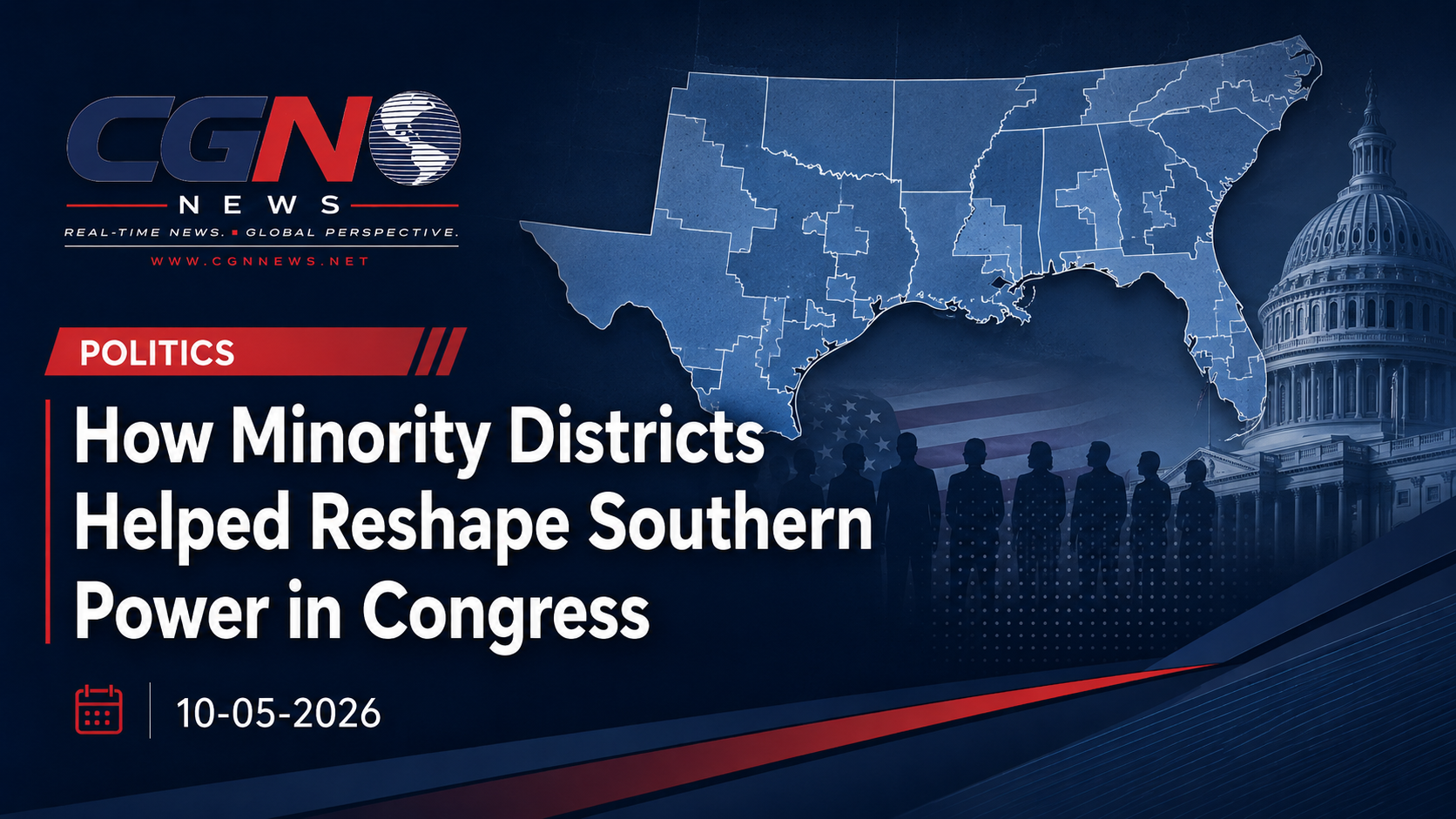
WASHINGTON | The fight over minority congressional districts in the South has moved back to the center of American politics, where court rulings, state maps and partisan strategy are reshaping which communities can elect candidates of their choice.
The New York Times examined how minority districts helped fuel the Republican Party’s Southern ascendancy in Congress, while the Associated Press reported on Tennessee’s newly enacted map splitting Memphis’ historically Democratic and majority-Black congressional district into three Republican-leaning districts. New York Times Associated Press
At issue is not only which party gains seats. It is whether communities with shared histories, neighborhoods and political interests remain whole enough to have meaningful representation. In Memphis, AP reported that longtime neighbors can now live in different districts tied to faraway, mostly white and rural communities.
Redistricting has always been political. But the latest round is happening after Supreme Court decisions weakened key Voting Rights Act protections that had limited how aggressively states could reduce minority electoral power. Republicans in several Southern states saw an opening to redraw maps before the midterms.
The politics are blunt. If minority voters are concentrated in one district, they may elect their preferred candidate. If they are split among several districts, their votes can be diluted. Mapmakers call this packing and cracking. Communities experience it as losing a congressional voice that understood their streets, schools, churches, businesses and history.
The Southern map fights are also a reminder that representation is not abstract. A member of Congress does not only vote on national bills. Members help local projects, federal grants, constituent services, disaster aid, military issues and infrastructure. When a city is divided across districts, accountability can become harder to see.
Republicans argue that Democrats and civil-rights groups have long used the Voting Rights Act to protect districts that functioned as Democratic seats. They say redistricting should not require states to sort voters by race in ways that violate constitutional principles. That argument has gained force with the Supreme Court’s conservative majority.
Democrats and civil-rights advocates counter that the law exists because race and political power have been intertwined in Southern history. In their view, weakening minority districts allows states to claim race-neutral motives while producing outcomes that reduce Black and Latino representation.
That tension has defined redistricting since the Voting Rights Act era. The law sought to stop states from using technical mapmaking to weaken minority voting power. Modern cases ask how far that protection can go before courts view it as an unconstitutional use of race.
The Roberts court has repeatedly reshaped election law. Its rulings have changed campaign finance, preclearance, partisan gerrymandering claims and voting-rights doctrine. The latest district fights are part of that larger pattern: courts reducing some federal oversight while states test the new boundaries.
The political stakes are enormous because House control can turn on a handful of seats. A map change in Tennessee, Alabama, Louisiana, Mississippi, South Carolina or Florida can affect national power. Congressional majorities are now narrow enough that district lines in one state can change the agenda in Washington.
That is why redistricting battles are moving faster and becoming more aggressive. States once treated congressional maps as decade-long structures after the census. Now mid-decade redistricting is becoming a tool of national competition. If one party redraws where it controls the statehouse, the other party looks for countermeasures where it can.
Minority voters can become the pressure point in that competition. A party trying to maximize seats may see a majority-Black district as a target. A civil-rights group may see the same district as a hard-won protection. Courts are asked to decide where partisan advantage ends and racial vote dilution begins.
The Memphis example carries special weight because of the city’s civil-rights history. Splitting a majority-Black city across districts is not simply a cartographic exercise. It raises questions about whether communities that shaped the nation’s democratic struggle still have the institutional power to defend their interests.
Congressional representation also affects policy. Districts with large minority populations may prioritize voting access, housing, public transportation, health disparities, small-business support, environmental justice and civil-rights enforcement differently than surrounding districts. Redrawing lines can change which issues receive attention.
The immediate legal fights will continue, but the broader trend is already visible. The South is entering a new redistricting era in which states are more willing to test weakened federal protections, courts are more skeptical of race-conscious remedies, and parties see maps as weapons in the fight for Congress.
The question for voters is whether representation remains connected to communities or becomes merely a product of partisan engineering. A legal map can still leave people feeling politically erased. That gap between legality and legitimacy is where the next phase of redistricting politics will unfold.
The deeper story is how minority congressional districts moves from a headline into decisions made by families, companies, public officials and markets. The visible event is only the front door. Behind it are systems of money, policy, logistics, public trust and institutional judgment that determine whether the moment becomes temporary noise or something with lasting consequences.
The Southern redistricting fight matters because it forces readers to look beyond the first facts and ask what kind of pressure is building. A single development can reveal whether an institution is prepared, whether leaders are communicating honestly and whether ordinary people have enough information to understand how the issue affects them.
For state legislatures, courts and Congress, the challenge is credibility. Public institutions and major organizations do not earn trust by issuing broad assurances. They earn it by giving clear explanations, making records available, acknowledging uncertainty and correcting course when facts change. In fast-moving stories, that kind of disciplined communication can be as important as the underlying decision.
For Black voters, civil-rights advocates and district residents, the issue is practical. People want to know what changed, what is known, what remains uncertain and what they should watch next. Good reporting should not bury that under jargon. It should translate complex developments into plain language without oversimplifying the stakes.
The financial dimension is also important. control of the U.S. House and the value of minority representation can change incentives quickly. When costs rise, risks spread or funding flows into a system, the people closest to the impact often feel the pressure before policymakers or executives finish explaining it.
The public should also pay attention to timing. Events that happen near elections, earnings reports, court deadlines, policy votes or travel seasons can carry more weight than the same facts would carry in a quieter period. Timing can determine whether a story stays local, becomes national or moves markets.
Another layer is accountability. The strongest public-interest stories are not built around shock alone. They are built around records, public consequences and the question of whether people with power are being honest about what they know. That standard matters whether the subject is government, business, health, sports, energy or entertainment.
A map line can decide whether a community has a practical voice in Washington also shapes the impact. A national story can land differently in Indiana, Chicago, Washington, London or a small local community. Readers need both the wider context and the human-level effect, because large systems are experienced through specific prices, services, votes, games, jobs, warnings and public decisions.
The first thing to watch is whether the official record grows clearer. Public statements, court filings, financial disclosures, health guidance, market data and agency reports can either confirm the direction of a story or force a rewrite of early assumptions. That is why source discipline matters.
The second thing to watch is whether the people affected have meaningful recourse. Information is useful only if it helps someone make a decision, protect a household, judge a leader, understand a market, plan travel, follow a team or participate in civic life.
The third thing to watch is whether the story produces a policy response or simply fades. Many public problems survive because attention moves on before systems change. The lasting question is whether this moment becomes evidence for reform, enforcement, investment or better oversight.
Public trust is fragile in these moments. People know when a story is being padded, spun or softened. They also know when reporting is clear about what is confirmed and careful about what is not. A strong public-facing account should be direct without being reckless.
That is especially true when the subject involves public money, health risk, courts, elections, security, markets or public safety. In those areas, even small errors can damage trust. The goal is not drama for its own sake. The goal is useful accountability.
The most important facts are often the least flashy. Dates, filings, official statements, score lines, dollar amounts, court actions, agency guidance and market data create the structure readers can rely on. Interpretation should sit on top of that structure, not replace it.
Careful distinction between legal mapmaking and democratic legitimacy does not weaken the story. It strengthens it. Readers can handle uncertainty when it is explained clearly. What they cannot trust is certainty that outruns the record.
The broader pattern is that modern news rarely fits one category. Business stories affect politics. Health stories affect travel and local services. Energy stories affect inflation. Technology stories affect privacy and work. Sports stories affect civic identity and economic activity. The connections are the point.
For CGN News readers, the value is not only knowing what happened. It is understanding why the event belongs in a larger public conversation. The best reporting connects the immediate fact to the system behind it and the choices ahead.
court challenges, new maps, state legislative sessions and Supreme Court signals will determine whether this story grows, stabilizes or fades. Until then, the responsible approach is to follow the records, keep the language precise and focus on the consequences for the people and institutions most affected.
Seen through voting rights, minority-district redistricting also shows how quickly a single news event can expose older tensions that were already present. The headline may be new, but the pressures beneath it often involve years of policy choices, market behavior, institutional habits and public frustration.
That is why the story should not be read as isolated. Southern congressional power shifting through maps and court doctrine is part of a broader pattern in which public systems are asked to operate under more stress, with less margin for error and more scrutiny from people who expect answers in real time.
The public record gives the story its foundation. court rulings, state maps, AP reporting and Voting Rights Act context help separate what is known from what is still developing. That distinction is not cosmetic. It is what allows readers to trust the article without feeling that the reporting is trying to push them faster than the facts allow.
For voters in minority communities and lawmakers in Washington, the practical question is what changes next. A story can be important because it changes law, money, travel, safety, local services, public health, political representation or how people understand the institutions around them.
The human effect is often quieter than the official action. A lawsuit, market report, court ruling, health alert or sports result may begin as a formal update. Its real impact is felt when a family changes plans, a worker faces uncertainty, a voter loses confidence, an investor rethinks risk or a patient looks for care.
That is why context belongs inside the article, not outside it. Readers should not have to know the background before they arrive. A strong public-facing story gives them the facts, the stakes, the timeline and the reason the subject matters now.
Pressure also tends to reveal weak points. A market shock exposes leverage. A health emergency exposes preparedness. A redistricting fight exposes legal assumptions. A nonprofit lawsuit exposes governance. A technology story exposes privacy or accountability gaps. A sports opener exposes roster strengths and weaknesses before the season narrative hardens.
Institutions often respond slowly because they are built for process. The public responds quickly because people need to make decisions. That gap is where confusion grows. Good reporting helps close it by making the available information clear without pretending that every answer is already known.
The most useful next step is transparency. When officials, companies, leagues, courts or agencies provide clear records and explanations, public confidence improves even when the news is uncomfortable. When they speak vaguely or delay, suspicion fills the space.
Readers should also watch whether the incentives change. Money, votes, ratings, energy prices, legal liability, staffing shortages and public pressure all shape what institutions do after the headline fades. The follow-through often matters more than the announcement.
CGN News is treating this story as part of a wider public-interest record: what happened, who is affected, what the documents or official sources show, and what consequences could follow. That approach keeps the focus on accountability rather than spectacle.
The clearest measure of importance is whether the story helps readers understand power. Who has it, who is using it, who is paying for it, who is affected by it and what evidence supports the public claims being made. That is the test this story meets.
Additional Reporting By: New York Times; Associated Press.