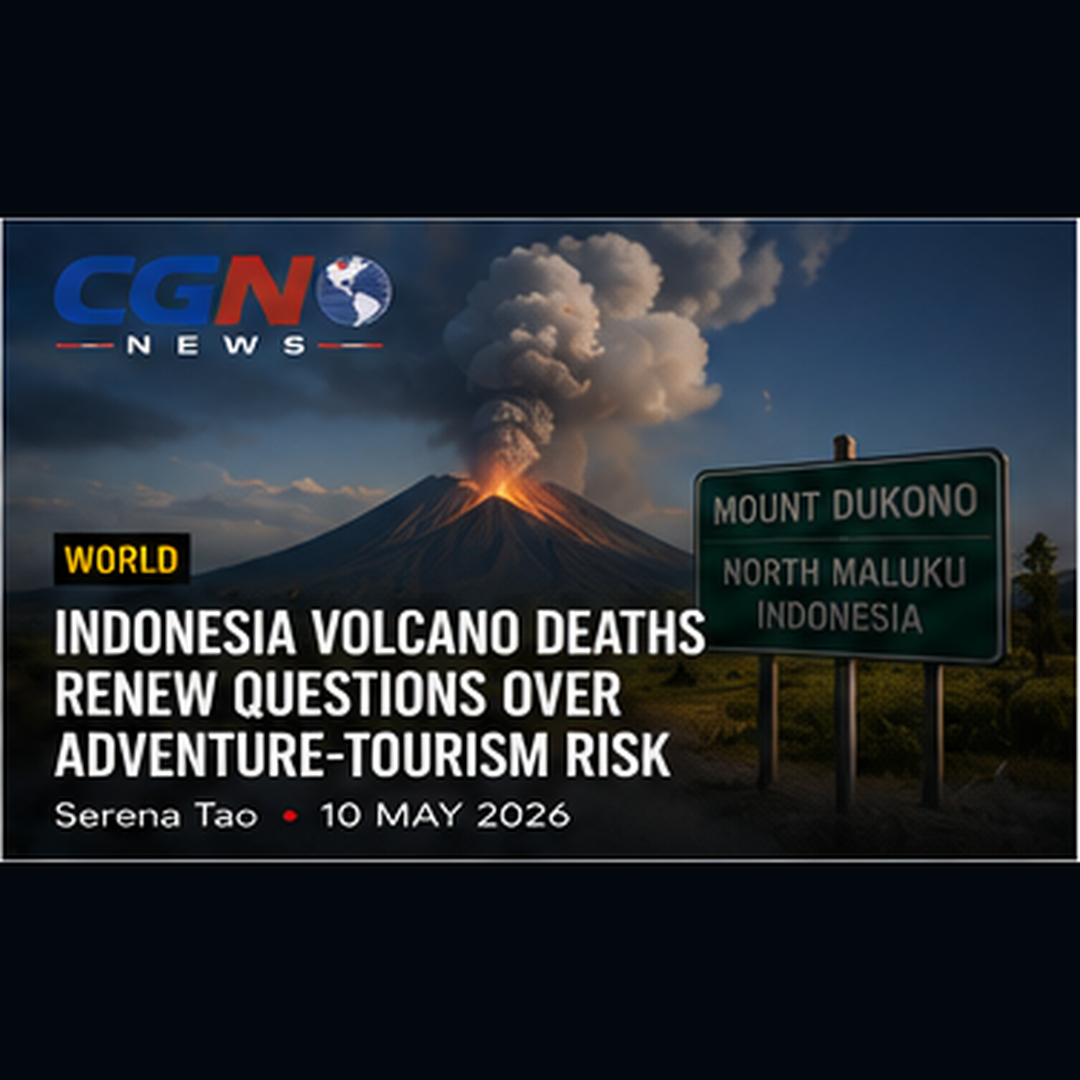
JAKARTA | The deaths of two Singaporean hikers after Mount Dukono erupted on Indonesia’s Halmahera island have renewed questions about adventure tourism, risk warnings and the limits of rescue operations in active volcanic zones.
Reuters reported that the two Singaporeans were confirmed dead and their bodies were retrieved from near the crater rim after the eruption. AP reported that the hikers were among 20 people involved in the incident and that authorities emphasized a ban on activity within a four-kilometer radius of the crater.
Mount Dukono is one of Indonesia’s active volcanoes, and Indonesia sits on the Pacific Ring of Fire, where volcanic and seismic hazards are part of national geography. That does not make every mountain closed to visitors, but it does mean warnings carry life-or-death importance.
The eruption sent ash high into the air and left rescuers facing dangerous terrain, heavy rain and continued volcanic activity. Reuters reported that nearly 150 personnel and thermal drones were involved in the operation, underscoring how difficult recovery becomes when a volcano remains unstable.
The victims were found under rock debris near the crater rim. That detail shows how quickly volcanic environments can become deadly. Ash, falling rocks, hot gases, poor visibility and unstable ground can turn a hiking route into a disaster zone within minutes.
Authorities maintained a high alert level and a four-kilometer exclusion zone. Those restrictions are not symbolic. They reflect scientific assessments of where hazards can occur. Ignoring them places hikers and rescuers at risk.
Adventure tourism often depends on proximity to danger. Travelers want remote landscapes, dramatic views and experiences that feel rare. But the same qualities that make a place appealing can make it unforgiving when conditions change.
The tragedy also raises communication questions. Were warnings clear? Were access routes controlled? Did visitors understand the alert level? Were local guides involved? In disaster review, those questions are not about blame alone; they are about prevention.
Indonesia has a large and important tourism economy, and volcanoes are part of its global appeal. The challenge is balancing access with safety. Too much restriction can hurt local livelihoods. Too little can expose visitors to hazards they may not fully understand.
For foreign visitors, risk can be harder to judge. A traveler may not understand local warning systems, language nuances or the difference between a scenic active volcano and a legally restricted danger zone. That makes multilingual communication and enforcement important.
Rescue operations also carry risk. When hikers enter restricted areas, emergency personnel may have to follow them into dangerous terrain. That extends the consequences beyond the individuals who made the decision to climb.
The use of drones in the search shows how technology can help, but technology cannot remove the hazard. Thermal drones can locate bodies or survivors, yet retrieval still requires people to move through unstable conditions.
The surviving hikers and families will now face grief, investigations and questions about responsibility. Public discussion should avoid reducing the victims to a cautionary tale. They were people whose deaths will affect families and communities. But respecting them also means learning from what happened.
Indonesia’s volcanology agency has a difficult public role. It must monitor hazards, issue warnings and maintain credibility. When warnings are ignored or poorly understood, authorities may need stronger barriers, clearer signage or stricter penalties.
Tour operators and local guides should also be part of the safety system. Guides can help visitors understand conditions, but they must be empowered to cancel trips and refuse unsafe routes without losing business to less cautious competitors.
The broader adventure-travel industry should treat this incident seriously. Extreme destinations are becoming more popular as travelers seek experiences beyond ordinary tourism. That trend increases the need for honest risk communication, not marketing that downplays danger.
Social media can also distort risk. Photos from crater rims and active landscapes can make dangerous places look accessible. A beautiful image rarely shows gas levels, unstable slopes, alert zones or the speed of volcanic change.
For governments, the policy challenge is enforcement. A restriction that exists only on paper may not protect anyone. Exclusion zones require monitoring, access control and cooperation with local communities.
Mount Dukono’s eruption is a reminder that nature tourism is not risk-free simply because it is scenic. Active volcanoes are living hazards. The safest adventure is one that respects the warning before the mountain proves why it was issued.
The next phase will test whether the institutions at the center of this story can turn public statements into verifiable action. For readers, the important questions are practical: what changes next, who is affected, which official records confirm the direction of the story, and whether leaders explain the tradeoffs clearly enough for the public to judge the outcome.
The next phase will test whether the institutions at the center of this story can turn public statements into verifiable action. For readers, the important questions are practical: what changes next, who is affected, which official records confirm the direction of the story, and whether leaders explain the tradeoffs clearly enough for the public to judge the outcome.
The next phase will test whether the institutions at the center of this story can turn public statements into verifiable action. For readers, the important questions are practical: what changes next, who is affected, which official records confirm the direction of the story, and whether leaders explain the tradeoffs clearly enough for the public to judge the outcome.
Indonesia’s geography makes volcanic tourism both attractive and hazardous. The same Ring of Fire landscape that draws visitors also produces eruptions, ash, earthquakes and rapidly changing conditions. Tourism policy has to be built around that reality, not around the assumption that danger can be predicted perfectly.
The presence of international hikers adds consular complexity. When foreign nationals die or are injured, local authorities must coordinate with embassies, families, hospitals and transport arrangements. A mountain rescue can quickly become a diplomatic and logistical operation.
The survivors’ accounts and official reports will matter for prevention. Investigators need to understand how the group accessed the area, whether warnings were visible, whether guides were involved and whether enforcement failed. Each answer points to a different safety fix.
Volcano hazards are often underestimated because they are intermittent. A mountain can appear calm for long stretches and then erupt with little warning. Visitors may treat earlier successful climbs as evidence that warnings are excessive, but volcanic risk is not linear.
Local communities also need support. Tourism can provide income for guides, transport operators and villages near volcanoes. Stricter enforcement should not simply remove livelihoods; it should build safer systems with training, licensed guiding and clear emergency protocols.
The tragedy should push a wider conversation about adventure marketing. Destinations can be promoted honestly without encouraging rule-breaking. The most responsible tourism culture treats warnings as part of the experience, not obstacles to a better photograph.
For a global audience, the importance of indonesia volcano deaths renew questions over adventure-tourism risk is that it does not sit neatly inside one border. The consequences move through diplomacy, markets, security planning, migration, law and public trust, which is why the story belongs in CGN’s World file rather than being treated as a narrow local development.
The first public test will be official documentation. Statements, court filings, election data, government decrees, diplomatic communiques and agency records will determine whether early claims hold up. In fast-moving international stories, the record often changes in pieces rather than all at once, and the most responsible coverage follows those pieces carefully.
The second test is whether affected communities see any practical change. International politics can sound distant, but it becomes real through prices, safety, visas, services, borders, infrastructure, aid access, courts and the ability of families to make plans. That is the level at which readers eventually judge whether leaders handled the moment well.
There is also a risk of overreading a single event. One hearing, reshuffle, election result, summit or security operation does not by itself settle a national direction. It is a signal. The question is whether the signal is confirmed by follow-through over the next days and weeks.
For policymakers, the story is a reminder that credibility is built before a crisis. Governments that explain decisions clearly and publish reliable information tend to have more room to maneuver when events become tense. Governments that hide details or shift explanations often lose trust precisely when they need it most.
For CGN News readers in the United States, the relevance is not only foreign-policy curiosity. World developments can affect trade, migration, security cooperation, energy, commodity prices, religious communities, university ties, humanitarian giving and the way American officials decide where to spend diplomatic attention.
The most useful next step is to watch institutions rather than personalities alone. Leaders matter, but institutions decide whether promises become enforceable actions. Courts, parliaments, ministries, regional bodies, security agencies and civil society groups will reveal whether this moment becomes durable change or a temporary headline.
For a global audience, the importance of indonesia volcano deaths renew questions over adventure-tourism risk is that it does not sit neatly inside one border. The consequences move through diplomacy, markets, security planning, migration, law and public trust, which is why the story belongs in CGN’s World file rather than being treated as a narrow local development.
The first public test will be official documentation. Statements, court filings, election data, government decrees, diplomatic communiques and agency records will determine whether early claims hold up. In fast-moving international stories, the record often changes in pieces rather than all at once, and the most responsible coverage follows those pieces carefully.
The second test is whether affected communities see any practical change. International politics can sound distant, but it becomes real through prices, safety, visas, services, borders, infrastructure, aid access, courts and the ability of families to make plans. That is the level at which readers eventually judge whether leaders handled the moment well.
There is also a risk of overreading a single event. One hearing, reshuffle, election result, summit or security operation does not by itself settle a national direction. It is a signal. The question is whether the signal is confirmed by follow-through over the next days and weeks.
For policymakers, the story is a reminder that credibility is built before a crisis. Governments that explain decisions clearly and publish reliable information tend to have more room to maneuver when events become tense. Governments that hide details or shift explanations often lose trust precisely when they need it most.
For CGN News readers in the United States, the relevance is not only foreign-policy curiosity. World developments can affect trade, migration, security cooperation, energy, commodity prices, religious communities, university ties, humanitarian giving and the way American officials decide where to spend diplomatic attention.
The most useful next step is to watch institutions rather than personalities alone. Leaders matter, but institutions decide whether promises become enforceable actions. Courts, parliaments, ministries, regional bodies, security agencies and civil society groups will reveal whether this moment becomes durable change or a temporary headline.
What this means
The Mount Dukono deaths matter because they show how adventure tourism can collide with official hazard warnings. Stronger communication, enforcement and guide accountability can reduce risk, but travelers also have to treat active-volcano restrictions as safety rules, not suggestions.
Additional Reporting By: Reuters; Associated Press.