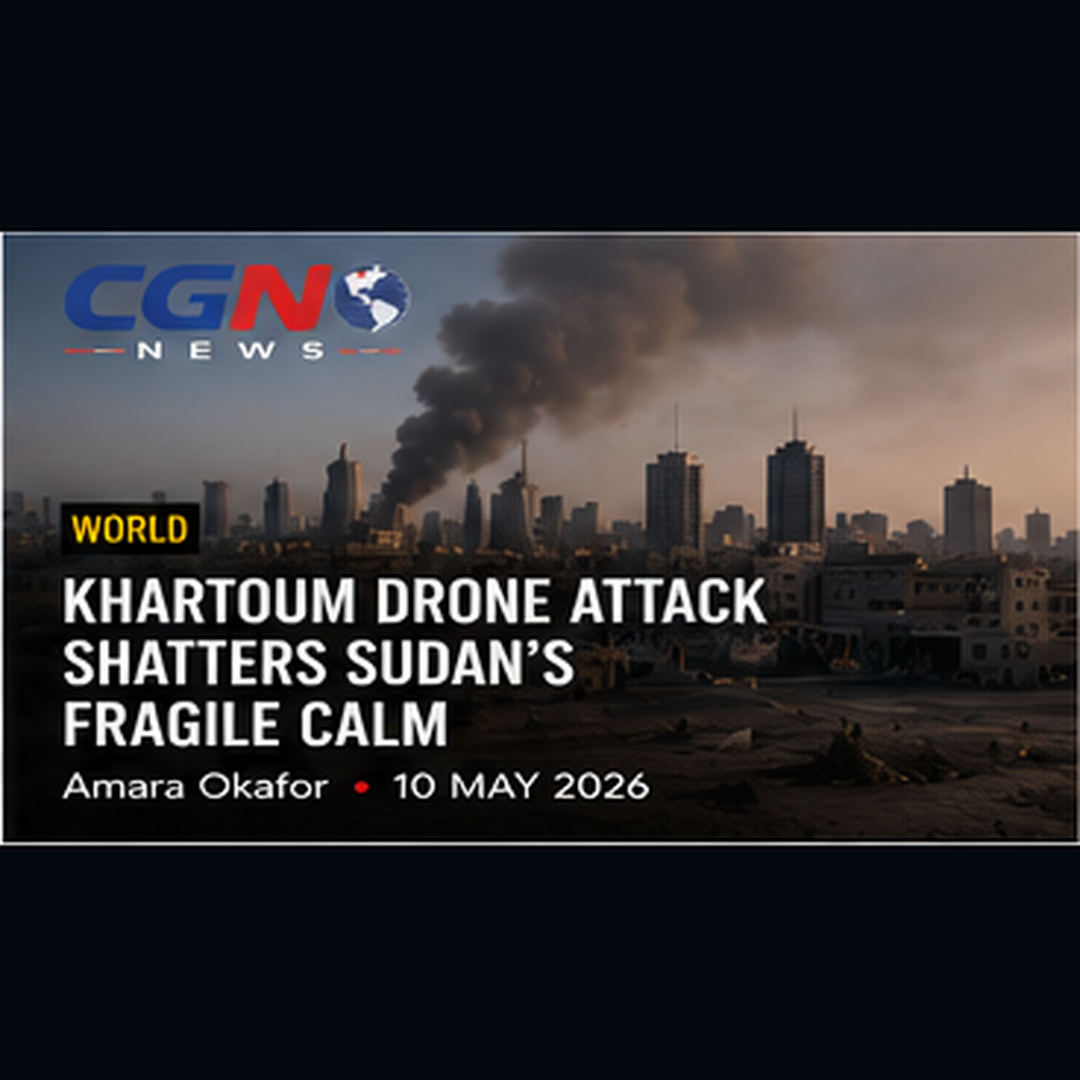
KHARTOUM | Drone attacks on Khartoum have shattered months of relative calm in Sudan’s capital, reviving fears that the country’s civil war is entering a more unpredictable and externally entangled phase.
Reuters reported that drones struck Khartoum airport and that Sudan’s armed forces accused the United Arab Emirates and Ethiopia of links to the attack, allegations Ethiopia rejected as baseless and the UAE denied. AP reported that Sudanese officials said the military downed a drone launched by the Rapid Support Forces at the main airport.
The airport attack matters because airports are symbols of state control and practical lifelines. When an airport is targeted, the message reaches beyond the runway. It raises questions about airspace security, civilian movement, aid access and whether the capital is truly under control.
Khartoum had experienced months of relative calm after the army regained control in 2025. That calm was fragile, but it allowed some residents to imagine a limited return to ordinary life. Drone strikes break that psychological recovery even when physical damage is limited.
Sudan’s war began in 2023 after tensions over integrating the Rapid Support Forces into the formal army. Since then, the conflict has become one of the world’s worst humanitarian crises, displacing millions and causing widespread hunger and disease.
Drone warfare has changed the conflict’s character. Drones allow forces to strike from distance, target infrastructure and create fear without traditional front lines. They also make external support harder to ignore because drones, parts, training and intelligence often move through international networks.
Sudan’s accusation that drones were linked to Ethiopia and the UAE adds a dangerous regional layer. Ethiopia rejected the accusation and accused Sudan of supporting hostile forces. The UAE denied involvement and called the claims misinformation. The fact that these accusations are being made publicly shows how distrust has widened beyond Sudan’s borders.
External involvement has long been one of the war’s most destabilizing factors. When regional powers are accused of backing one side or another, peace efforts become harder. Each party believes the other has foreign support, and each outside actor denies responsibility or frames its role differently.
The Rapid Support Forces did not immediately claim every attack described in reporting, but residents and officials have linked the broader drone campaign to RSF activity. The ambiguity itself is destabilizing. In a conflict full of propaganda and denial, uncertainty can be used as a weapon.
Civilian risk remains severe. AP reported an earlier RSF drone strike killed civilians on Khartoum’s outskirts, while Reuters described strikes in Omdurman, al-Obeid and Kenana as part of a sudden barrage. Even when infrastructure is the target, civilians live and work near the blast zones.
The airport’s temporary suspension of flights shows how quickly a single strike can disrupt basic functions. Routine safety checks may resume operations, but public confidence is harder to restore. People need to believe roads, airports and hospitals will not be hit without warning.
Sudan’s army will likely use the attacks to justify stronger military measures and diplomatic pressure against alleged foreign backers. The RSF and its supporters may frame the army as unable to secure the capital. Both narratives can push the war further from compromise.
Humanitarian agencies face added difficulty when urban centers become targets. Aid operations require predictable routes, storage, communications and air access. Drone attacks increase insurance, security costs and uncertainty for organizations already working under extreme strain.
The war’s economic damage is also deepening. Strikes on airports, fuel depots or infrastructure can slow commerce, raise prices and weaken any chance of near-term recovery. War does not only kill directly; it destroys the systems people need to survive.
Regional diplomacy must now manage not only Sudan’s internal combatants but also accusations against neighboring and Gulf states. Egypt, Saudi Arabia, the United States and African institutions all have an interest in preventing the conflict from becoming a wider proxy war.
The UAE’s denial and Ethiopia’s rejection of the accusation are important, but denials alone will not calm the situation if Sudan’s army continues presenting evidence and threatening response. Independent verification becomes essential.
For Sudanese civilians, the central issue is exhaustion. Years of war, displacement and hunger have left people with little margin. A renewed threat to Khartoum makes return, rebuilding and family reunification harder.
The attacks also demonstrate that military control of territory does not necessarily mean security. An army can hold a city and still fail to protect it from drones. That reality changes how wars are fought and how post-conflict recovery is planned.
Sudan’s fragile calm has been broken. Whether that becomes a temporary shock or a new phase of escalation will depend on whether the parties, and the foreign governments around them, choose restraint, transparency and negotiation over accusation and retaliation.
The next phase will test whether the institutions at the center of this story can turn public statements into verifiable action. For readers, the important questions are practical: what changes next, who is affected, which official records confirm the direction of the story, and whether leaders explain the tradeoffs clearly enough for the public to judge the outcome.
The next phase will test whether the institutions at the center of this story can turn public statements into verifiable action. For readers, the important questions are practical: what changes next, who is affected, which official records confirm the direction of the story, and whether leaders explain the tradeoffs clearly enough for the public to judge the outcome.
The next phase will test whether the institutions at the center of this story can turn public statements into verifiable action. For readers, the important questions are practical: what changes next, who is affected, which official records confirm the direction of the story, and whether leaders explain the tradeoffs clearly enough for the public to judge the outcome.
The drone accusations also illustrate how modern conflicts blur lines between battlefield and diplomacy. A strike may be military in effect, but the argument over who supplied the drone, where it launched and who authorized support becomes an international dispute.
Khartoum’s residents are again forced to measure daily life through risk. A capital recovering from fighting needs schools, markets, hospitals and transport to function. Drone attacks interrupt that fragile normalcy even when casualties are limited.
The UAE and Ethiopia denials do not end the matter because Sudan’s army is using the accusations to frame the war as externally fueled. Whether the evidence is accepted by outsiders will shape diplomatic pressure and possibly future sanctions discussions.
The airport is particularly sensitive for humanitarian logistics. Sudan’s crisis requires aid movement, evacuation options and connections with the outside world. If airports become repeated targets, the humanitarian operating environment becomes even more dangerous.
The war’s fragmentation makes accountability difficult. Multiple armed actors, external accusations and information warfare mean the public often receives competing versions of events. Independent verification is essential, but difficult in active conflict.
Sudan’s fragile calm was valuable because people need time to return, repair and breathe. Drone attacks steal that time. The next diplomatic task is not only stopping one strike pattern, but preventing the capital from sliding back into a constant state of siege.
For a global audience, the importance of khartoum drone attack shatters sudan’s fragile calm is that it does not sit neatly inside one border. The consequences move through diplomacy, markets, security planning, migration, law and public trust, which is why the story belongs in CGN’s World file rather than being treated as a narrow local development.
The first public test will be official documentation. Statements, court filings, election data, government decrees, diplomatic communiques and agency records will determine whether early claims hold up. In fast-moving international stories, the record often changes in pieces rather than all at once, and the most responsible coverage follows those pieces carefully.
The second test is whether affected communities see any practical change. International politics can sound distant, but it becomes real through prices, safety, visas, services, borders, infrastructure, aid access, courts and the ability of families to make plans. That is the level at which readers eventually judge whether leaders handled the moment well.
There is also a risk of overreading a single event. One hearing, reshuffle, election result, summit or security operation does not by itself settle a national direction. It is a signal. The question is whether the signal is confirmed by follow-through over the next days and weeks.
For policymakers, the story is a reminder that credibility is built before a crisis. Governments that explain decisions clearly and publish reliable information tend to have more room to maneuver when events become tense. Governments that hide details or shift explanations often lose trust precisely when they need it most.
The most useful next step is to watch institutions rather than personalities alone. Leaders matter, but institutions decide whether promises become enforceable actions. Courts, parliaments, ministries, regional bodies, security agencies and civil society groups will reveal whether this moment becomes durable change or a temporary headline.
For a global audience, the importance of khartoum drone attack shatters sudan’s fragile calm is that it does not sit neatly inside one border. The consequences move through diplomacy, markets, security planning, migration, law and public trust, which is why the story belongs in CGN’s World file rather than being treated as a narrow local development.
The first public test will be official documentation. Statements, court filings, election data, government decrees, diplomatic communiques and agency records will determine whether early claims hold up. In fast-moving international stories, the record often changes in pieces rather than all at once, and the most responsible coverage follows those pieces carefully.
The second test is whether affected communities see any practical change. International politics can sound distant, but it becomes real through prices, safety, visas, services, borders, infrastructure, aid access, courts and the ability of families to make plans. That is the level at which readers eventually judge whether leaders handled the moment well.
There is also a risk of overreading a single event. One hearing, reshuffle, election result, summit or security operation does not by itself settle a national direction. It is a signal. The question is whether the signal is confirmed by follow-through over the next days and weeks.
For policymakers, the story is a reminder that credibility is built before a crisis. Governments that explain decisions clearly and publish reliable information tend to have more room to maneuver when events become tense. Governments that hide details or shift explanations often lose trust precisely when they need it most.
For CGN News readers in the United States, the relevance is not only foreign-policy curiosity. World developments can affect trade, migration, security cooperation, energy, commodity prices, religious communities, university ties, humanitarian giving and the way American officials decide where to spend diplomatic attention.
The most useful next step is to watch institutions rather than personalities alone. Leaders matter, but institutions decide whether promises become enforceable actions. Courts, parliaments, ministries, regional bodies, security agencies and civil society groups will reveal whether this moment becomes durable change or a temporary headline.
What this means
The Khartoum drone attacks matter because they show Sudan’s war can still reach the capital and threaten core infrastructure. The bigger danger is that accusations involving regional actors turn an already devastating civil war into a broader proxy conflict.
Additional Reporting By: Reuters; Reuters; Associated Press.