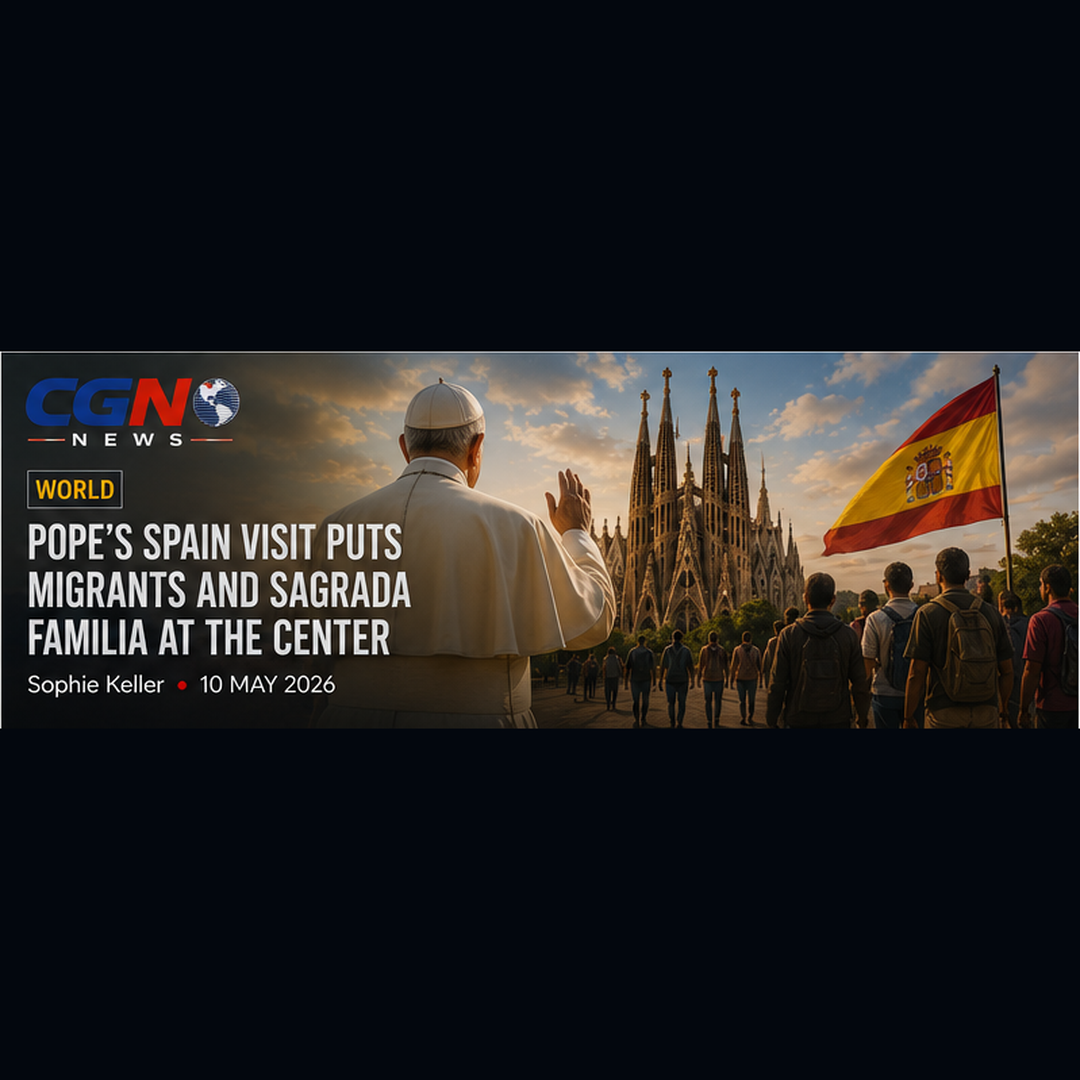
ROME | Pope Leo XIV’s planned June visit to Spain will place two very different symbols at the center of one trip: Barcelona’s Sagrada Familia, a monument of Catholic art and architecture, and the Canary Islands, a frontline of Europe’s migration debate.
The Associated Press reported that Pope Leo XIV will visit Spain from June 6 to 12, inaugurating the central Tower of Jesus Christ at the Sagrada Familia during the 100th anniversary year of architect Antoni Gaudí’s death. Reuters reported that the itinerary includes Madrid, Montserrat, Barcelona, Tenerife and Gran Canaria, with planned meetings with migrants and humanitarian organizations.
The trip is designed as a religious event, but it cannot avoid politics. Spain is a Catholic-majority country with a secular government, a divided migration debate and a visible role in Europe’s argument over how to handle people arriving from Africa.
The Sagrada Familia stop gives the visit a powerful cultural image. Gaudí’s basilica is both unfinished history and living devotion, a building that has become one of the most recognizable Christian spaces in Europe. Inaugurating its central tower will be a moment of architectural and spiritual symbolism.
But the Canary Islands stop may carry the trip’s strongest moral message. The islands are a major entry point for migrants traveling by dangerous sea routes from Africa. By meeting migrants and aid organizations there, the pope is aligning the visit with one of the most difficult humanitarian questions facing Europe.
Pope Francis had planned a migrant-focused visit before his death, and Leo’s decision to carry that emphasis forward suggests continuity in Catholic social teaching. The Church’s message on migration often challenges both governments and voters who want simpler answers.
Spain’s government has supported a migrant amnesty program that allows many undocumented immigrants to seek legal status. Conservative critics have opposed that approach. The pope’s visit will not settle the policy debate, but it will place the human beings at the center of it.
The Madrid portion of the trip also matters. Leo is expected to meet Spanish leaders, including King Felipe VI and Queen Letizia, and address parliament. A papal speech to lawmakers is not routine theater; it is a direct engagement with the moral responsibilities of democratic institutions.
For the Vatican, Spain offers a European stage beyond Italy. Reuters described it as Leo’s first trip to a European Union country outside Italy. That gives the visit added weight as a signal of how the new pope intends to engage Europe’s social conflicts.
The trip also connects past and present Catholic identity. The Sagrada Familia represents beauty, permanence and theological imagination. The migrant stops represent vulnerability, borders and contemporary moral urgency. Together they show a papacy trying to speak through both art and encounter.
The challenge is that migration is politically combustible. European leaders face voters who are worried about housing, public services, identity and security. Humanitarian organizations warn that restrictive policies can endanger lives. The pope will have to speak to suffering without sounding indifferent to social tensions.
Catholic teaching does not require governments to ignore borders, but it does insist that migrants retain human dignity. That distinction is central to how the Church has framed the issue. The question for European politics is whether dignity can survive in policy systems designed to deter arrivals.
The Sagrada Familia inauguration may draw global attention beyond ordinary Catholic audiences. Architecture, tourism and faith overlap there. The basilica is a devotional site and a global landmark, and the tower’s completion offers a rare moment when a sacred building’s long history visibly advances.
Gaudí’s legacy gives the trip another layer. His architecture blended technical daring with religious imagination. In a secularizing Europe, the basilica still draws millions, showing that religious art can remain culturally powerful even when formal religious practice changes.
For Spain, the visit is also a national spotlight. It brings attention to Barcelona, Madrid and the Canary Islands while highlighting the country’s role in European migration management. That spotlight can be welcome and uncomfortable at the same time.
The pope’s planned visit to Lampedusa after Spain reinforces the migration theme. Lampedusa is another symbol of Europe’s southern border. Taken together, the trips suggest that Leo wants early travel to define his papacy around places where faith meets human movement.
Critics may argue that papal visits offer symbolism more than policy. That is partly true. Popes do not write immigration law. But symbolism can shape moral pressure, media attention and the way citizens understand distant suffering.
For Catholics, the trip may ask whether the Church’s public witness is limited to heritage or extends to the stranger at the border. For European governments, it may ask whether policy can be firm without being dehumanizing.
The most powerful image of the trip may be the contrast itself: a soaring church tower and a migrant reception center. One points upward. The other demands attention to people who arrive with little protection. Leo’s Spain visit will try to hold both in the same frame.
The next phase will test whether the institutions at the center of this story can turn public statements into verifiable action. For readers, the important questions are practical: what changes next, who is affected, which official records confirm the direction of the story, and whether leaders explain the tradeoffs clearly enough for the public to judge the outcome.
The next phase will test whether the institutions at the center of this story can turn public statements into verifiable action. For readers, the important questions are practical: what changes next, who is affected, which official records confirm the direction of the story, and whether leaders explain the tradeoffs clearly enough for the public to judge the outcome.
The next phase will test whether the institutions at the center of this story can turn public statements into verifiable action. For readers, the important questions are practical: what changes next, who is affected, which official records confirm the direction of the story, and whether leaders explain the tradeoffs clearly enough for the public to judge the outcome.
Spain’s internal politics will shape how the visit is received. Supporters of migrant regularization may welcome the pope’s emphasis on human dignity. Critics may argue that religious leaders underestimate the pressures migration places on housing, services and border systems.
The Vatican often works through moral framing rather than legislative detail. That can frustrate policymakers, but it is also the role popes frequently choose: to remind states that efficiency and deterrence cannot become the only values in public life.
The Sagrada Familia stop will likely dominate images from the trip, but the Canary Islands stop may define its message. The juxtaposition is intentional. A church that rises toward heaven and a reception center for vulnerable people both ask what faith means in public.
The visit also reflects Europe’s religious complexity. Formal practice may be declining in many countries, but Catholic institutions still influence debates over migration, poverty, education and cultural identity. The pope’s presence can reopen conversations that secular politics often treats as settled.
For Barcelona, the tower inauguration is a civic and spiritual milestone. The basilica is tied to tourism, architecture, local identity and devotion. Its newest central tower gives the city a global moment that goes beyond ecclesiastical ceremony.
For migrants in the Canary Islands, the visit may bring attention that daily suffering rarely receives. The challenge for church and state will be ensuring that attention leads to better protection, processing and humane treatment rather than a brief burst of symbolism.
For a global audience, the importance of pope’s spain visit puts migrants and sagrada familia at center of june trip is that it does not sit neatly inside one border. The consequences move through diplomacy, markets, security planning, migration, law and public trust, which is why the story belongs in CGN’s World file rather than being treated as a narrow local development.
The first public test will be official documentation. Statements, court filings, election data, government decrees, diplomatic communiques and agency records will determine whether early claims hold up. In fast-moving international stories, the record often changes in pieces rather than all at once, and the most responsible coverage follows those pieces carefully.
The second test is whether affected communities see any practical change. International politics can sound distant, but it becomes real through prices, safety, visas, services, borders, infrastructure, aid access, courts and the ability of families to make plans. That is the level at which readers eventually judge whether leaders handled the moment well.
There is also a risk of overreading a single event. One hearing, reshuffle, election result, summit or security operation does not by itself settle a national direction. It is a signal. The question is whether the signal is confirmed by follow-through over the next days and weeks.
For policymakers, the story is a reminder that credibility is built before a crisis. Governments that explain decisions clearly and publish reliable information tend to have more room to maneuver when events become tense. Governments that hide details or shift explanations often lose trust precisely when they need it most.
For CGN News readers in the United States, the relevance is not only foreign-policy curiosity. World developments can affect trade, migration, security cooperation, energy, commodity prices, religious communities, university ties, humanitarian giving and the way American officials decide where to spend diplomatic attention.
The most useful next step is to watch institutions rather than personalities alone. Leaders matter, but institutions decide whether promises become enforceable actions. Courts, parliaments, ministries, regional bodies, security agencies and civil society groups will reveal whether this moment becomes durable change or a temporary headline.
What this means
The Spain trip matters because it places Catholic beauty and migrant vulnerability in one itinerary. Pope Leo XIV is using architecture and encounter to define the social priorities of his early papacy, especially Europe’s obligation to treat migrants as human beings rather than abstractions.
Additional Reporting By: Associated Press; Reuters.