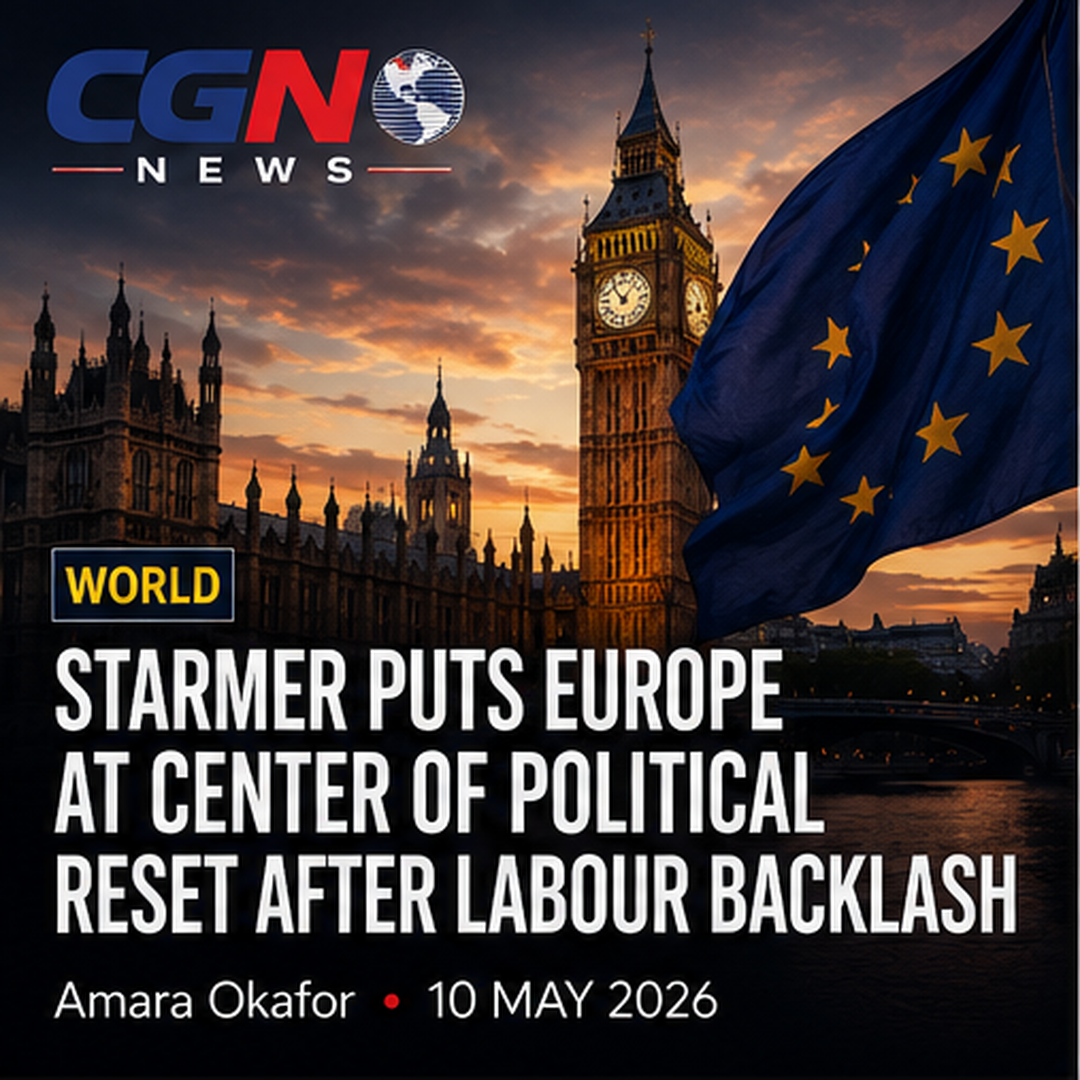
LONDON | Prime Minister Keir Starmer is trying to turn Britain’s relationship with Europe into the core of a political reset after a bruising local-election result and growing unrest inside the Labour Party.
Reuters reported that Starmer is preparing a fightback after Labour suffered its worst local-election defeat in more than three decades, with the prime minister expected to argue that Britain must put itself “at the heart of Europe” as it seeks economic growth, military rebuilding and energy security.
The message is deliberately bigger than trade. Starmer is trying to link Europe to the daily pressures that have weakened confidence in his government: slow growth, security anxiety, household energy costs and a sense that Britain has not found a stable post-Brexit economic model.
The political risk is that Europe remains one of the most emotionally charged subjects in British public life. Nearly a decade after the Brexit vote, closer ties with the European Union can sound practical to some voters and like retreat to others. That is why Starmer’s language matters. He is not promising to reverse Brexit, but he is trying to define cooperation as a tool of national strength rather than as an admission of failure.
The timing is difficult. Reuters reported that more than 30 Labour lawmakers have called for Starmer to resign or set out a plan to leave after the party’s local-election losses. Labour has never removed a sitting prime minister, but the pressure shows how quickly a government majority can lose emotional control of its own story.
Starmer’s supporters will argue that a Europe reset gives Labour a governing narrative. Younger voters and many urban Labour supporters are more comfortable with closer EU ties than older Brexit-era swing voters. A more efficient trading relationship could also help businesses that have spent years dealing with border friction, paperwork and uncertainty.
The opposition will attack from both sides. Conservatives and Reform figures can accuse Starmer of reopening Brexit by stealth. Liberal Democrats and pro-European critics can argue that he is still avoiding the bigger question of customs, market access and freedom of movement. The prime minister’s room for maneuver is therefore narrow: close enough to Europe to show results, but not so close that he appears to be ignoring the referendum settlement.
Defense gives Starmer one of his strongest arguments. The war in Ukraine, U.S. pressure on NATO allies and the instability of global security have made European coordination harder to dismiss as bureaucracy. Britain can remain outside the EU and still need European partners for weapons production, intelligence alignment, sanctions and continent-wide deterrence.
Energy security is another practical bridge. Britain’s energy market is linked to Europe through interconnectors, investment flows and common exposure to global commodity shocks. A government trying to lower bills and improve resilience has reason to discuss Europe not as ideology, but as infrastructure.
The economic case is more complicated. Business groups want smoother trade, but voters will judge the reset by whether it changes wages, prices and public services. A diplomatic phrase will not solve the cost of living. Starmer has to show how cooperation leads to measurable gains, not just better atmospherics in Brussels and European capitals.
The internal Labour dimension may be the most immediate. A prime minister under pressure often needs to show urgency without looking panicked. Starmer’s promise of bold reform is intended to signal that he understands incrementalism is not enough. But if the reset lacks concrete proposals, critics inside the party may see it as another speech rather than a change in direction.
Europe also gives Labour a contrast with populist politics. Starmer can frame cooperation as seriousness in an age of disruption: trade rules, defense planning, energy infrastructure and climate coordination rather than slogans. That pitch may appeal to voters tired of volatility, but it can also sound technocratic unless tied to daily concerns.
The central question is whether Britain’s post-Brexit debate has matured enough for a more practical conversation. Many voters no longer want to relitigate 2016. They want cheaper bills, better jobs, security and public services that work. If Starmer can connect Europe to those outcomes, the reset may help him. If he cannot, it may look like a familiar argument wearing new language.
There is also a diplomatic test. European leaders may welcome warmer British language, but they will still protect the EU’s rules and interests. Closer ties are not free. Britain may have to accept obligations, regulatory alignment or compromises that become politically sensitive at home.
For international observers, the moment reflects a wider question about the post-Brexit order. Britain left the EU but cannot leave Europe’s geography, security environment or economic neighborhood. Starmer’s reset is an attempt to acknowledge that reality without overturning the formal settlement.
The next stage will depend on whether the government follows the speech with specific measures. Trade facilitation, defense cooperation, energy planning and youth mobility arrangements would each carry different political costs. The shape of the details will determine whether the reset is treated as pragmatic statecraft or as another round in the Brexit war.
For Labour, the danger is that Europe becomes a substitute for harder domestic decisions. Public frustration over housing, the National Health Service, immigration, wages and local services will not disappear because the prime minister gives a Europe speech. The reset can only work if it supports a broader governing plan.
For Britain, the opportunity is that the country may be moving beyond the most rigid phase of the Brexit debate. A mature relationship with Europe would accept that sovereignty and cooperation are not always opposites. The question is whether Starmer can make that argument before his own party decides time is running out.
The next phase will test whether the institutions at the center of this story can turn public statements into verifiable action. For readers, the important questions are practical: what changes next, who is affected, which official records confirm the direction of the story, and whether leaders explain the tradeoffs clearly enough for the public to judge the outcome.
The next phase will test whether the institutions at the center of this story can turn public statements into verifiable action. For readers, the important questions are practical: what changes next, who is affected, which official records confirm the direction of the story, and whether leaders explain the tradeoffs clearly enough for the public to judge the outcome.
The next phase will test whether the institutions at the center of this story can turn public statements into verifiable action. For readers, the important questions are practical: what changes next, who is affected, which official records confirm the direction of the story, and whether leaders explain the tradeoffs clearly enough for the public to judge the outcome.
The bureau perspective from London is important because this is not merely a Westminster leadership story. Britain’s relationship with Europe affects manufacturers, universities, defense suppliers, energy planners and local communities that depend on trade and investment. When a prime minister makes Europe the centerpiece of a reset, the effects eventually move from speeches into customs paperwork, supply chains, contracts and workplace decisions.
There is also a credibility test in the phrase “reset.” British voters have heard many resets since Brexit: resets with Brussels, resets in industrial policy, resets in migration management and resets inside parties. The word only matters if the government can attach it to specific changes that businesses and households notice. Otherwise, it becomes a signal of political distress rather than governing direction.
The most sensitive issue may be movement of people. Starmer can promise no return to freedom of movement, but closer cooperation with Europe often raises practical questions about youth mobility, visas, seasonal workers and professional qualifications. Each can be defended on economic grounds, but each can also be attacked as reopening a border argument the government says it wants to leave behind.
Businesses will be listening for details on regulatory alignment. Companies that trade with Europe want fewer frictions, but sovereignty-minded voters and opposition parties will ask whether Britain is again taking rules from Brussels without representation inside EU institutions. That tension is the unresolved core of the post-Brexit settlement.
For Labour lawmakers, the strategic question is whether Europe can energize the party’s pro-European base without alienating voters who switched sides during the Brexit years. A Europe-first reset may be popular among activists and younger voters, but general elections are often decided by people who want competence more than constitutional drama.
The broader lesson is that geography keeps reasserting itself. Britain can choose its legal distance from the European Union, but it cannot choose a different neighborhood. Trade, defense, migration, energy and climate policy all bring London back to European partners whether politicians use the language of integration or not.
For a global audience, the importance of starmer puts europe at center of political reset after labour backlash is that it does not sit neatly inside one border. The consequences move through diplomacy, markets, security planning, migration, law and public trust, which is why the story belongs in CGN’s World file rather than being treated as a narrow local development.
The first public test will be official documentation. Statements, court filings, election data, government decrees, diplomatic communiques and agency records will determine whether early claims hold up. In fast-moving international stories, the record often changes in pieces rather than all at once, and the most responsible coverage follows those pieces carefully.
The second test is whether affected communities see any practical change. International politics can sound distant, but it becomes real through prices, safety, visas, services, borders, infrastructure, aid access, courts and the ability of families to make plans. That is the level at which readers eventually judge whether leaders handled the moment well.
There is also a risk of overreading a single event. One hearing, reshuffle, election result, summit or security operation does not by itself settle a national direction. It is a signal. The question is whether the signal is confirmed by follow-through over the next days and weeks.
For policymakers, the story is a reminder that credibility is built before a crisis. Governments that explain decisions clearly and publish reliable information tend to have more room to maneuver when events become tense. Governments that hide details or shift explanations often lose trust precisely when they need it most.
For CGN News readers in the United States, the relevance is not only foreign-policy curiosity. World developments can affect trade, migration, security cooperation, energy, commodity prices, religious communities, university ties, humanitarian giving and the way American officials decide where to spend diplomatic attention.
The most useful next step is to watch institutions rather than personalities alone. Leaders matter, but institutions decide whether promises become enforceable actions. Courts, parliaments, ministries, regional bodies, security agencies and civil society groups will reveal whether this moment becomes durable change or a temporary headline.
What this means
Starmer’s Europe reset matters because it is both foreign policy and political survival. If closer ties produce visible economic, security or energy benefits, they could help Labour rebuild authority. If the promise remains vague, Europe could become another point of division inside a government already under pressure.
Additional Reporting By: Reuters.