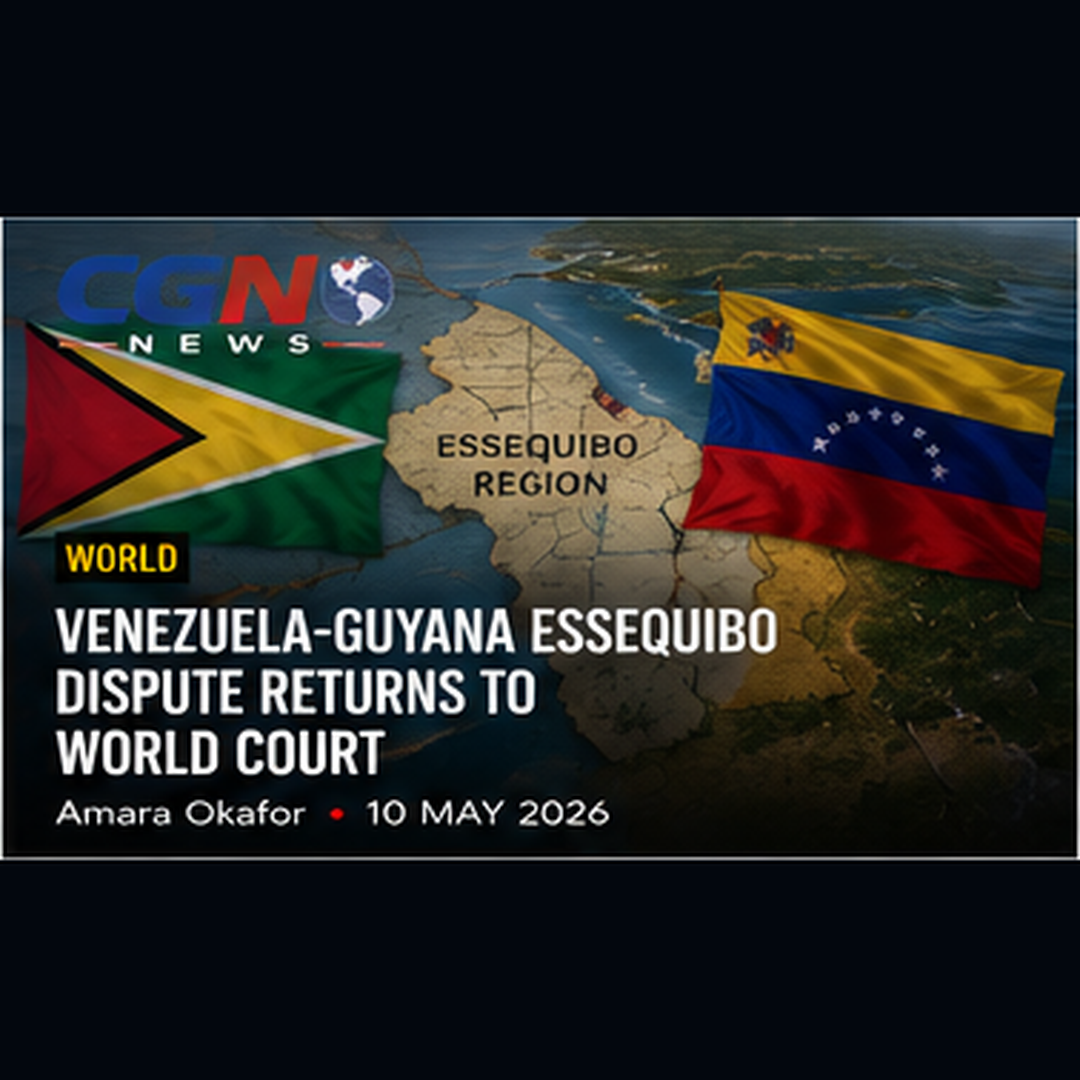
THE HAGUE | The Venezuela-Guyana dispute over Essequibo has returned to the International Court of Justice, bringing one of Latin America’s most consequential territorial fights back into a courtroom where law can clarify claims but may not be enough to guarantee compliance.
Reuters reported that Venezuela’s interim president Delcy Rodriguez arrived in the Netherlands for the hearing over the Esequibo region. AP reported that Rodríguez traveled to defend Venezuela’s claim over the mineral- and oil-rich area, while Guyana argues the territory belongs to it and has asked the court to validate the 1899 boundary decision.
Essequibo is not a small border technicality. The disputed region covers roughly 62,000 square miles and represents a large share of Guyana’s territory. It is rich in minerals and sits near offshore oil development that has transformed Guyana’s economic outlook.
Venezuela argues that colonial-era boundaries and the 1966 Geneva Agreement support its claim. Guyana argues that the 1899 arbitration award established the border and that the ICJ should affirm that boundary. The case therefore turns on history, treaty interpretation and international law.
The oil dimension gives the dispute modern urgency. Guyana has become one of the world’s most closely watched new oil producers. Its offshore discoveries have attracted global energy attention and raised the stakes of any territorial challenge from its larger neighbor.
For Guyana, Essequibo is a sovereignty issue and a survival issue. If the disputed region represents such a large portion of national territory, any challenge to it can feel existential. That is why Georgetown has treated the court process as central to defending the state itself.
For Venezuela, the claim carries historical and nationalist weight. Governments in Caracas have long invoked Essequibo as unfinished territorial justice. That message can be politically useful, especially during domestic uncertainty or external pressure.
The appearance of Delcy Rodríguez adds another layer because Venezuela’s internal political situation has changed dramatically. Reuters noted that this was her first official trip to Europe since assuming power after the capture of Nicolás Maduro by U.S. forces earlier in 2026. That makes the legal case part of Venezuela’s attempt to project continuity and authority.
The ICJ can issue binding rulings, but enforcement is complicated. International law depends partly on state compliance and partly on political pressure. If a losing side refuses to accept a decision, the dispute can move from legal judgment to diplomatic and security management.
That is why regional actors will watch closely. The Caribbean Community, Brazil, the United States and other governments all have an interest in avoiding escalation. A territorial crisis near major energy infrastructure could destabilize investment and security across the region.
Military conflict is not inevitable, but rhetoric matters. Nationalist language can lock leaders into positions that are hard to soften later. Legal proceedings are meant to reduce that risk by giving states a nonviolent forum, but courtrooms do not automatically calm domestic politics.
Guyana’s economic transformation makes the dispute even more sensitive. Oil revenue can fund development, infrastructure and social programs, but it also makes the country more strategically important. New wealth attracts attention from investors and from rivals.
For Venezuela, energy decline and political instability have made external claims more attractive as symbols of sovereignty. Essequibo can be framed as a national cause that transcends ordinary party politics.
The court process will likely move more slowly than political narratives. Hearings, filings and rulings take time. Markets and governments, however, often react to headlines, troop movements, statements and diplomatic signals long before final judgments.
The dispute also tests whether small states can rely on international legal institutions when challenged by larger neighbors. Guyana’s case is therefore being watched beyond South America by countries that see courts as one way to protect territorial integrity.
Venezuela’s participation in the proceedings does not necessarily mean it accepts everything about the court’s jurisdiction. States often appear to defend procedural positions while maintaining objections. That complexity can be difficult for the public to follow but is central to international litigation.
The most dangerous scenario would be a legal loss followed by domestic pressure for defiance. The most constructive scenario would be a ruling that both sides manage through diplomacy, regional guarantees and restraint.
For now, the return to the World Court is important because it keeps the fight in legal channels. That alone is valuable. But the region should not confuse a hearing with a resolution. The hard part will be what happens after the judges speak.
Essequibo’s future will shape not only Venezuela and Guyana but the credibility of international law in a resource-rich region where territorial claims, energy revenue and political instability are becoming harder to separate.
The next phase will test whether the institutions at the center of this story can turn public statements into verifiable action. For readers, the important questions are practical: what changes next, who is affected, which official records confirm the direction of the story, and whether leaders explain the tradeoffs clearly enough for the public to judge the outcome.
The next phase will test whether the institutions at the center of this story can turn public statements into verifiable action. For readers, the important questions are practical: what changes next, who is affected, which official records confirm the direction of the story, and whether leaders explain the tradeoffs clearly enough for the public to judge the outcome.
The next phase will test whether the institutions at the center of this story can turn public statements into verifiable action. For readers, the important questions are practical: what changes next, who is affected, which official records confirm the direction of the story, and whether leaders explain the tradeoffs clearly enough for the public to judge the outcome.
The dispute is also a test for international investors. Oil companies and contractors need to know whether the legal environment around Guyana’s energy boom remains stable. Even if offshore projects continue, territorial uncertainty can affect financing and risk premiums.
Guyana’s rapid oil rise has changed its geopolitical weight. A small country that once attracted limited global attention now sits at the center of major energy discussions. That transformation makes the Essequibo case more sensitive because territorial claims now intersect with new wealth.
Venezuela’s domestic politics can amplify the claim. Leaders facing internal pressure often use territorial issues to rally nationalist sentiment. That does not mean the claim is only political theater, but it does affect how compromise is perceived at home.
The ICJ process also shows why legal patience matters. Territorial cases often involve old maps, treaties and arbitration records that do not fit modern media cycles. Courts move slowly because the consequences are permanent.
Regional diplomacy should focus on lowering temperature around the case. The countries involved need space to argue in court without mobilizing military symbolism or public threats. That requires restraint not only from Caracas and Georgetown, but also from outside powers with influence.
The strongest outcome would be one in which the ruling, whatever it says, is managed through law and diplomacy. The worst outcome would be a court process that becomes another trigger for confrontation in a region already adjusting to Guyana’s oil boom.
For a global audience, the importance of venezuela-guyana essequibo dispute returns to world court is that it does not sit neatly inside one border. The consequences move through diplomacy, markets, security planning, migration, law and public trust, which is why the story belongs in CGN’s World file rather than being treated as a narrow local development.
The first public test will be official documentation. Statements, court filings, election data, government decrees, diplomatic communiques and agency records will determine whether early claims hold up. In fast-moving international stories, the record often changes in pieces rather than all at once, and the most responsible coverage follows those pieces carefully.
The second test is whether affected communities see any practical change. International politics can sound distant, but it becomes real through prices, safety, visas, services, borders, infrastructure, aid access, courts and the ability of families to make plans. That is the level at which readers eventually judge whether leaders handled the moment well.
There is also a risk of overreading a single event. One hearing, reshuffle, election result, summit or security operation does not by itself settle a national direction. It is a signal. The question is whether the signal is confirmed by follow-through over the next days and weeks.
For policymakers, the story is a reminder that credibility is built before a crisis. Governments that explain decisions clearly and publish reliable information tend to have more room to maneuver when events become tense. Governments that hide details or shift explanations often lose trust precisely when they need it most.
The most useful next step is to watch institutions rather than personalities alone. Leaders matter, but institutions decide whether promises become enforceable actions. Courts, parliaments, ministries, regional bodies, security agencies and civil society groups will reveal whether this moment becomes durable change or a temporary headline.
For a global audience, the importance of venezuela-guyana essequibo dispute returns to world court is that it does not sit neatly inside one border. The consequences move through diplomacy, markets, security planning, migration, law and public trust, which is why the story belongs in CGN’s World file rather than being treated as a narrow local development.
The first public test will be official documentation. Statements, court filings, election data, government decrees, diplomatic communiques and agency records will determine whether early claims hold up. In fast-moving international stories, the record often changes in pieces rather than all at once, and the most responsible coverage follows those pieces carefully.
The second test is whether affected communities see any practical change. International politics can sound distant, but it becomes real through prices, safety, visas, services, borders, infrastructure, aid access, courts and the ability of families to make plans. That is the level at which readers eventually judge whether leaders handled the moment well.
There is also a risk of overreading a single event. One hearing, reshuffle, election result, summit or security operation does not by itself settle a national direction. It is a signal. The question is whether the signal is confirmed by follow-through over the next days and weeks.
For policymakers, the story is a reminder that credibility is built before a crisis. Governments that explain decisions clearly and publish reliable information tend to have more room to maneuver when events become tense. Governments that hide details or shift explanations often lose trust precisely when they need it most.
For CGN News readers in the United States, the relevance is not only foreign-policy curiosity. World developments can affect trade, migration, security cooperation, energy, commodity prices, religious communities, university ties, humanitarian giving and the way American officials decide where to spend diplomatic attention.
The most useful next step is to watch institutions rather than personalities alone. Leaders matter, but institutions decide whether promises become enforceable actions. Courts, parliaments, ministries, regional bodies, security agencies and civil society groups will reveal whether this moment becomes durable change or a temporary headline.
What this means
The Essequibo case matters because it blends territorial sovereignty, oil wealth and the limits of international enforcement. A court ruling can clarify the law, but regional stability will depend on whether governments accept the process and resist nationalist escalation.
Additional Reporting By: Reuters; Associated Press; Reuters.