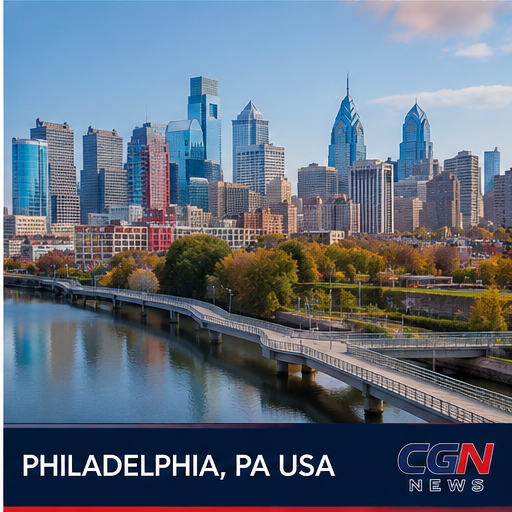
PHILADELPHIA | A vacant Market East storefront has been turned into “Revisit 1876,” a free public exhibition that uses Philadelphia’s Centennial Exposition to connect the city’s industrial past with present-day questions about public space, downtown retail and who gets included in civic memory.
WHYY reported that the Center City District Foundation took over the former Ross Dress for Less space in the Lits Building, an 8,000-square-foot site that had been empty for two years, for an exhibit recreating parts of the 1876 Centennial Exposition in Fairmount Park. The exhibition is open through December and arrives as Philadelphia prepares for the nation’s semiquincentennial.
Why Market East matters
The location is part of the story. Market East has long been a test of Philadelphia’s downtown recovery, retail strategy and public-space imagination. Using an empty storefront for a history exhibition does not solve vacancy, but it changes the immediate experience of a corridor that often suffers when blank windows dominate the street. A cultural pop-up gives passersby a reason to enter, look around and connect the block to a larger Philadelphia story.
What the exhibition covers
WHYY reported that “Revisit 1876” recreates four main Centennial Exposition buildings: Main Hall, Machinery Hall, Agricultural Hall and Memorial Hall, the only one still standing and now home to the Please Touch Museum. The exhibition presents the Centennial as America’s first World’s Fair and a moment when Philadelphia showcased its manufacturing strength as a “Workshop to the World.”
The exhibit also confronts the darker side of the fair. WHYY reported that it includes the Women’s Pavilion and the exclusionary conditions surrounding who was represented and who had to fight for space. That makes the project more than a nostalgia installation. It asks readers to think about how a city celebrates greatness while still acknowledging who was left out.
Why it matters now
Philadelphia’s 1876 fair was a civic brand campaign, an economic showcase and a statement of national identity. In 2026, the city is again thinking about visitors, public storytelling and the use of major anniversaries to attract attention. The Market East installation links those questions to current debates about vacancies, downtown activity, tourism and whether temporary cultural uses can support commercial corridors.
What to watch next
Watch whether the exhibit draws sustained foot traffic, whether other vacant storefronts are activated before 2026 anniversary events and whether Center City leaders treat temporary cultural use as a one-time patch or a recurring tool for downtown recovery.
Public history as downtown strategy
The pop-up works because it serves two purposes at once. It gives Philadelphia a public-history installation as the country approaches the 250th anniversary moment, and it gives Market East a more active street presence. Empty storefronts can make a downtown block feel stalled. A free exhibition does not replace retail, but it turns vacancy into a civic doorway.
That matters because Market East has been asked to carry a heavy burden in Philadelphia’s recovery conversation. It sits between tourism, transit, retail, office work, convention activity and neighborhood use. If a corridor is filled with blank glass, the public reads decline. If the same space is filled with history, maps, artifacts and visitors, the block becomes part of the city’s story again.
The Centennial as a mirror
The 1876 Centennial Exposition was a showcase of industry and national ambition, but WHYY’s reporting notes that “Revisit 1876” also addresses exclusion and the Women’s Pavilion. That balance is essential. Anniversary programming can become boosterism if it only celebrates power and progress. A better public-history project lets readers see both the achievement and the people who had to fight for recognition inside it.
The exhibit’s recreation of major fair buildings gives visitors a simple path into a complicated event. Main Hall, Machinery Hall, Agricultural Hall and Memorial Hall were not just buildings; they represented what Philadelphia wanted the world to see. The fact that only Memorial Hall survives also makes the exhibition a reminder that civic memory is fragile. Cities decide, again and again, which structures and stories remain visible.
Economic and civic stakes
For downtown leaders, the key question is whether cultural activation produces repeat foot traffic or simply a temporary novelty. If the exhibition draws visitors through December, it could help make the case for more flexible use of vacant spaces. If it is isolated from retail, transit and nearby businesses, its effect may be limited. Either way, it gives residents a concrete example of how public history can be placed directly in a commercial corridor rather than kept inside a museum district.
Why vacant-space storytelling matters
A city’s downtown story is often told through what occupies its ground floor. Restaurants, shops, theaters and public exhibits invite people to slow down. Empty storefronts do the opposite. They tell pedestrians that a block is waiting for something else. By placing “Revisit 1876” inside a former retail space, the Center City District Foundation is not only telling a history story; it is testing whether history can change how a struggling corridor feels.
That is a practical experiment. A storefront exhibition can attract office workers, tourists, students, residents and convention visitors who might not make a separate museum trip. It lowers the barrier to entry because it is visible from the street and free to enter. If it works, the model could be repeated in other vacant spaces where the city needs activity but does not yet have permanent tenants.
The risk of anniversary nostalgia
The exhibit’s strongest editorial choice is that it does not treat 1876 as simple glory. Philadelphia’s Centennial Exposition projected industrial confidence and national ambition, but it also reflected exclusion. The Women’s Pavilion example is central because it shows that representation was contested even inside a celebration of progress. That makes the exhibition more honest and more useful.
A future CGN follow-up should ask who visits, whether nearby businesses benefit and whether public-history pop-ups can survive after anniversary funding fades. The lasting measure is not only attendance; it is whether the project helps Philadelphians see Market East as a place where civic life can still happen.
Additional Reporting By: WHYY