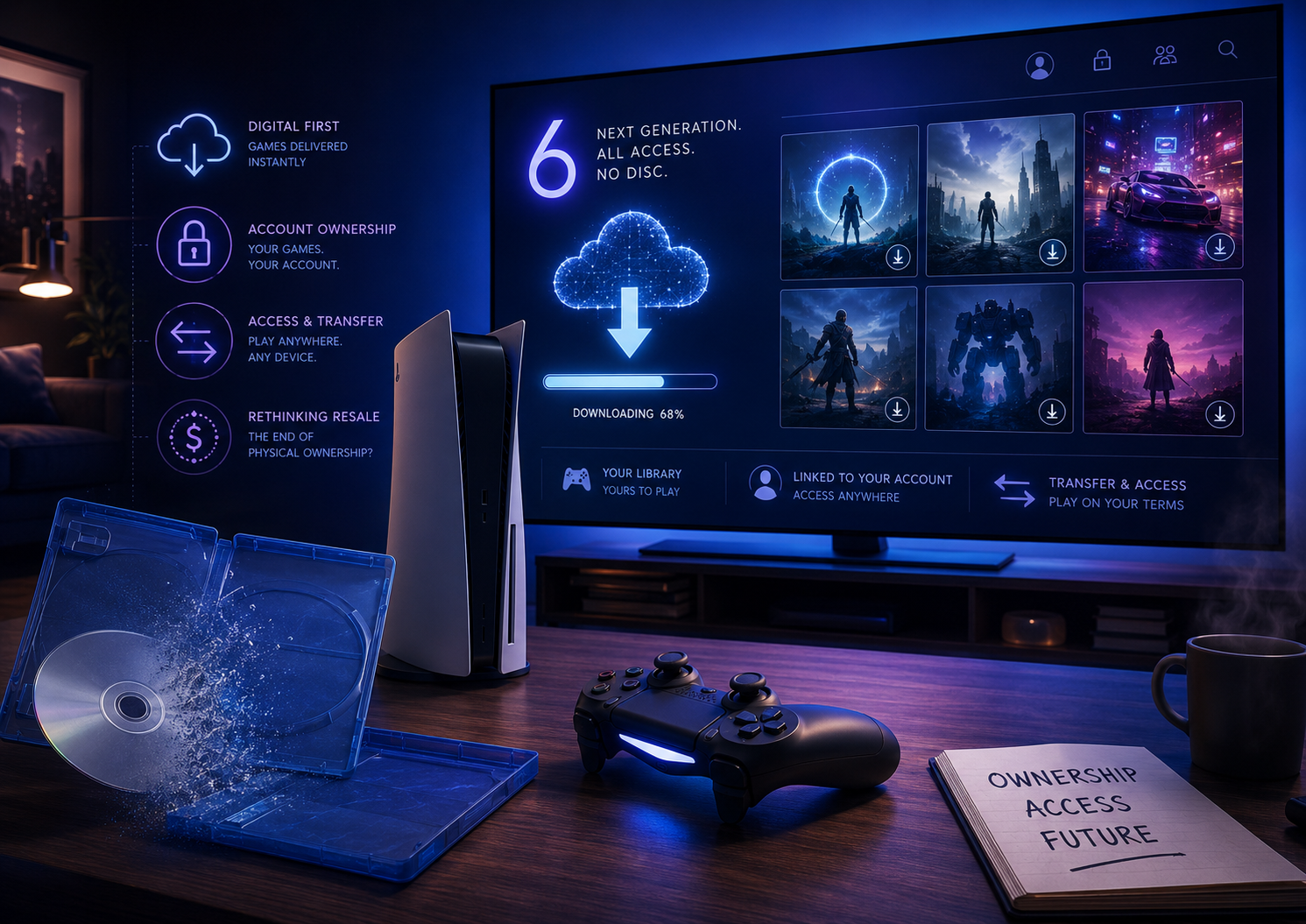
SAN FRANCISCO | Grand Theft Auto VI is already positioned as one of the largest entertainment launches of the decade. Now, its rollout is also becoming a test of what players actually own when a blockbuster game arrives without a traditional disc.
Rockstar Games’ official Grand Theft Auto VI page lists the game as coming Nov. 19, 2026, for PlayStation 5 and Xbox Series X|S, with preorders open and an Ultimate Edition promoted alongside preorder bonuses. Reuters reported that Take-Two priced the base edition at $79.99 and the Ultimate Edition at $99.99, putting the release at the center of wider industry debates about premium game pricing. GamesRadar+ and The Guardian reported that boxed copies at launch are expected to contain a download code rather than a game disc, meaning the retail box would function as packaging for a digital entitlement, not as a playable physical copy.
CGN News is treating this as a technology, consumer-products and digital-rights story. This is not a review of Grand Theft Auto VI, not a prediction of sales performance and not an unsupported claim about every possible future edition. The central issue is narrower and more important for consumers: when even the biggest console releases move away from discs, the meaning of ownership changes.
What Rockstar has put in front of buyers
Rockstar’s official site confirms the release date, preorder campaign, platforms and promotional framing for Grand Theft Auto VI. The official page highlights PlayStation 5 and Xbox Series X|S, an Ultimate Edition and preorder bonuses tied to the game’s Vice City setting. That puts the game in the center of the current console generation and signals the scale of the marketing campaign ahead of launch.
Reuters reported that Take-Two is pricing the standard version at $79.99 and the Ultimate Edition at $99.99. The same report noted the importance of GTA VI not only to Take-Two, but to the wider video-game market, because Grand Theft Auto V has sold around 230 million copies since its 2013 release. That history helps explain why a distribution decision around GTA VI matters beyond one title. If a release this large pushes deeper into digital delivery, other publishers, retailers and platform owners will study the result closely.
The disc issue is where the consumer story sharpens. GamesRadar+ reported that Rockstar’s preorder information said physical copies would contain a code redeemable for the digital download and that a disc would not be included in the box. The Guardian also reported that boxed copies available in shops would contain a download code rather than a physical disc at launch. In practice, that means some buyers may still receive something that looks like a physical product on a shelf, but the actual right to play would depend on digital redemption, account access and download infrastructure.
What changes when the box has no disc
Physical game discs once carried several meanings at once. They were installation media. They were proof of purchase. They were collector objects. They could be traded, resold, loaned to a friend, wrapped as a gift or kept on a shelf after a console generation ended. They also gave players with slower internet connections a way to install large games without relying entirely on a download.
A code-in-box model weakens or removes several of those functions. A player may still buy a box, but the core value is no longer the disc. It is the code, the platform account and the continuing availability of the digital storefront. Once a code is redeemed, resale becomes difficult or impossible in the traditional sense. Lending becomes more limited. Collectors lose the playable artifact they expected. Players with data caps, slow rural broadband or shared household internet may face a larger practical burden.
For many consumers, the tradeoff may still feel acceptable. Digital games can preload before release, update automatically and remain attached to a console account. A player who moves between consoles may prefer an account-based library. A publisher can patch bugs quickly and avoid the cost and logistics of producing discs. But convenience does not erase the policy question. Digital access is not the same thing as physical possession, and a major launch like GTA VI makes that difference harder to ignore.
Why this matters for the games industry
Grand Theft Auto is not a niche test case. A smaller release can move quietly to digital delivery without forcing a broad market conversation. GTA VI cannot. Retailers, console makers, publishers, collectors, preservation advocates and ordinary players all have a stake in how this launch works.
For retailers, the concern is obvious. Physical software helped bring customers into stores and created resale, trade-in and collector activity around major releases. If boxed copies become codes, independent game stores and physical-media specialists lose one of the strongest remaining reasons to stock a blockbuster title. Larger retailers may still carry the product because demand is high, but the long-term value of the game aisle changes if the box no longer contains a disc.
For publishers and platform holders, the economics may look different. Digital delivery can reduce manufacturing costs, simplify day-one updates and place more transactions inside controlled storefronts. Platform accounts also make the consumer relationship more durable. A player’s library, payment method, subscription status and preorder bonuses can all sit inside the same ecosystem. That may be efficient, but it also shifts leverage away from the player and toward the platform and publisher.
The move also fits the modern blockbuster model. Many major games are no longer finished in the old physical-media sense on release day. They are patched, expanded, tuned and monetized over time. In that world, a disc can become less like a complete standalone product and more like a license token or partial installer. A code-in-box launch simply makes that reality more visible.
The consumer question: convenience or control
The strongest argument for digital delivery is convenience. Players can preorder, preload and play when the game unlocks. They do not have to wait for a package, visit a store or keep track of a disc. For households already used to streaming movies, downloading music and storing books in digital libraries, the shift may feel familiar.
The strongest argument against it is control. A disc can be owned, transferred, sold or preserved in ways that a digital code usually cannot. A digital copy may depend on account standing, platform rules, regional availability, server access and terms of service that can change over time. Most players may never run into a serious problem, but the structure of ownership is different.
That difference is especially important for families, collectors and rural players. A parent buying a gift may expect a boxed product to work like earlier console games. A collector may want something playable years later. A player with unreliable broadband may prefer installation media. A resale buyer may depend on secondhand markets to afford new releases. A code-in-box model does not serve all of those buyers equally.
That does not make the model inherently anti-consumer in every case. It does mean companies need to be unusually clear. Packaging, retailer listings and preorder pages should leave no doubt about whether a disc is included, when downloads become available, how large the installation will be, whether an internet connection is required and what happens if a code is lost, redeemed on the wrong account or tied to the wrong region.
What remains unclear
Several details still require caution. CGN News is not confirming every regional package, every retailer listing or any possible later collector or disc edition. Reports about possible future physical-disc releases have circulated, but buyers should rely on official publisher information and retailer listings before making a purchase decision.
It also remains unclear how much resistance the model will face once the game is actually available. Some players may complain online and still buy the game immediately. Others may wait, choose digital storefronts directly or hold out for a later disc-based version if one is ever offered. The practical market signal will come from preorders, retailer behavior, customer-service volume and post-launch sales patterns.
The biggest unknown is whether GTA VI becomes a one-off exception or a market marker. Publishers have been moving toward digital delivery for years, but the largest releases still carry symbolic weight. If a code-in-box launch succeeds with limited commercial damage, other companies may see less reason to maintain disc production for future premium releases.
What to watch next
Watch Rockstar’s official preorder language, PlayStation and Xbox storefront terms, file-size disclosures, refund rules, regional retail pages and any updated guidance from Take-Two. Those details will matter more to buyers than broad industry arguments.
Also watch retailers. Large chains may stock code-in-box copies because demand is too strong to ignore. Smaller stores that rely on trade-ins and collector trust may be more cautious. Their reaction will show whether the physical game market still has enough leverage to shape publisher decisions or whether the center of gravity has moved decisively to platform accounts and digital storefronts.
For players, the practical advice is simple: check the listing before buying. A box on a shelf does not necessarily mean a disc in the box. For the industry, the question is bigger. GTA VI may not decide the future of game ownership by itself, but it will test how much of that future consumers are willing to accept when the game is big enough.
Additional Reporting By: Rockstar Games; Reuters; BBC News; GamesRadar+; The Guardian