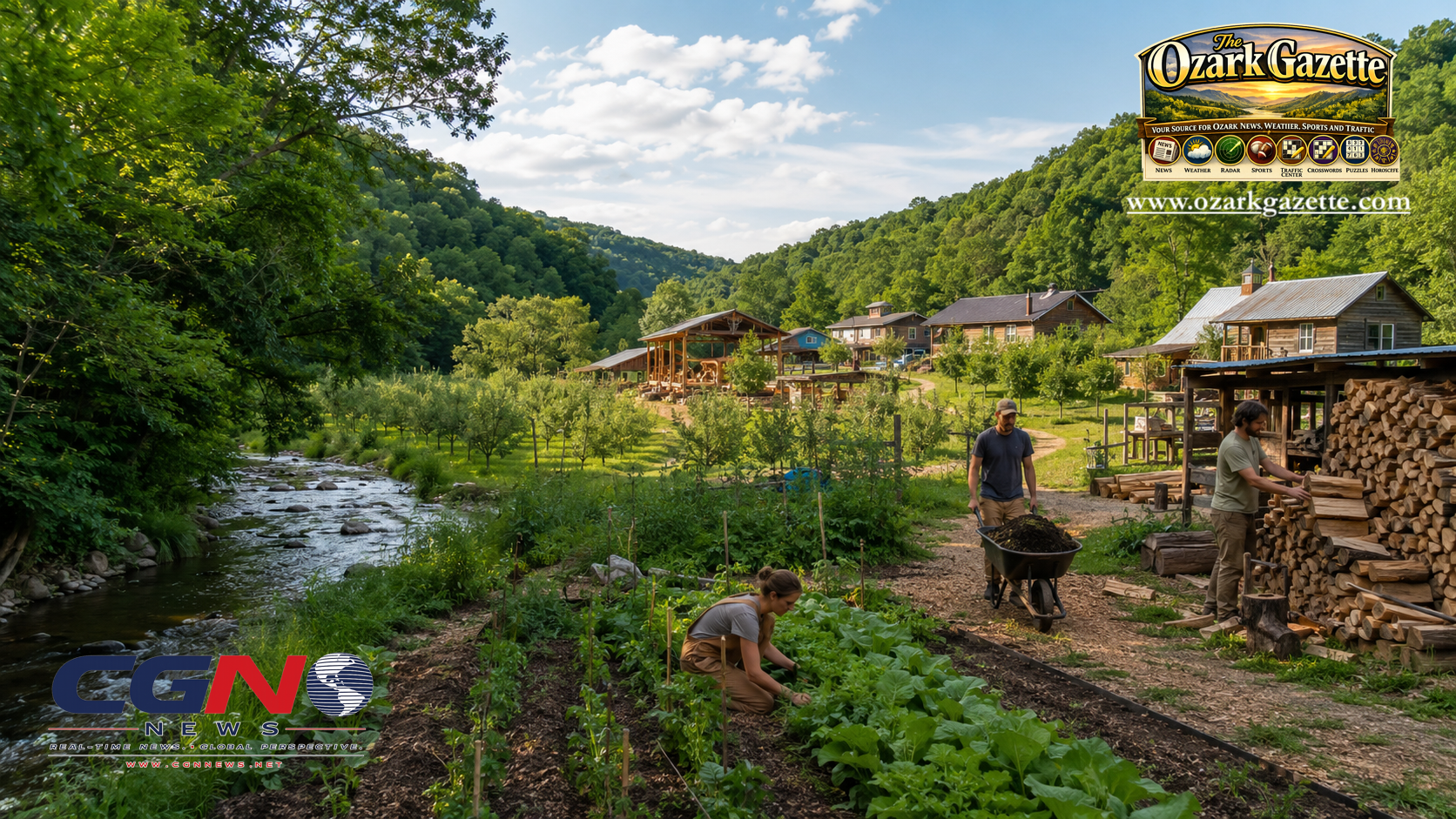
TECUMSEH, MO | In the hills of Ozark County, where gravel roads narrow into woods and the ordinary work of rural life rarely asks for applause, East Wind Community offers a useful reminder that environmental stewardship does not always announce itself with slogans. Sometimes it looks more like a creek path walked before breakfast, a wheelbarrow of compost pushed toward a garden bed, a stack of split firewood drying for winter, or a sawmill turning local timber into boards that will hold up another season of life. Near Tecumseh, on nearly 1,200 acres shaped by Lick Creek, gardens, pasture and forest, the environmental story is not only about preserving land. It is about what people choose to do with their days once they decide that land should be cared for as part of daily work, not as an occasional gesture.
The place itself does some of the explaining. East Wind says more than 800 acres of its property have been set aside as a type of nature preserve known simply as “The Woods,” while the remaining acreage holds infrastructure and pastures. Lick Creek runs through and around the property before draining into Norfork Lake. Trails and dirt roads move through glades, ravines, caves, wooded hills, swimming holes and rock beaches. Read that description slowly and the environmental frame becomes clearer. This is not a community speaking about nature as scenery alone. It is describing a working Ozarks landscape where creek water, tree cover, soil, wildlife habitat and human routines are tied to one another in ways that are practical, intimate and ongoing.
That matters in a region where the line between livelihood and landscape has always been thin. In the Missouri Ozarks, people often know the woods not as an abstraction but as a source of heat, shade, forage, recreation, danger, memory and survival. East Wind fits into that local tradition in its own distinct way. The community’s environmental story is not built around a single policy campaign or one-time project. Instead, it grows out of repeated acts of maintenance: tending orchards, rotating crops, watching for tree disease, milling lumber, making use of deadfall and dead standing timber, and trying to leave enough forest intact that the land remains more than a production site. That kind of stewardship is quiet, but it is still stewardship.
East Wind’s own language often returns to that combination of work and place. On its main community page, East Wind says it is a community of people living and working together in the hills of the Missouri Ozarks, holding land, labor and resources in common while placing value on cooperation, nonviolence and direct democracy. Those values might sound philosophical at first glance, but on the ground they translate into something more concrete: a system in which environmental habits are difficult to separate from social habits. When labor is shared, the work of maintaining a woodlot, hauling compost, processing food or helping a neighbor is not treated as an extracurricular interest. It becomes part of how the place functions.
What East Wind is and what it is not
For readers unfamiliar with East Wind, the simplest accurate description is that it is an egalitarian, income-sharing intentional community near Tecumseh. East Wind says members share income and expenses and collectively provide for food, clothing, shelter, medical care, education and other needs as the community is able. The self-governance page describes a system built around bylaws, meetings, petitions, elections, boards and community votes. That is a different structure than most rural households or standard businesses use, but it is also more grounded than caricature. East Wind is not best understood as a curiosity. It is better understood as a long-running social arrangement for organizing work, property, decision-making and daily life.
Its roots are also well documented. East Wind’s history page says the community was founded on May 1, 1974, by a group influenced by lessons learned at Twin Oaks in Virginia. 417 Magazine reported that East Wind was established in 1974 after Twin Oaks reached capacity and situated it within the back-to-the-land movement in southwest Missouri. That history matters because it places East Wind within a larger American search, especially in the 1970s, for ways of living that were less hierarchical, less consumption-driven and more experimental about shared labor. East Wind did not emerge out of nowhere. It came out of a moment when some people were asking not only how to live differently, but how to anchor that difference in rural land and everyday production.
Still, longevity is part of what makes East Wind worth writing about now. Many communities founded in that era dissolved. East Wind did not. That does not mean it found a perfect formula. In fact, some of the most useful material on its own site points in the other direction. East Wind says its bylaws are intentionally minimal, that legislation and policy tools continue to change, and that community life requires patience, accountability and compromise. Its labor page speaks plainly about the need for members to do a fair share of work and about the tensions that can arise when labor is not recorded honestly or obligations are not met. Those details are not flaws in the story. They are part of what makes the story believable. A working environmental feature should not present East Wind as a perfect model. It should present it as a place where ideals have had to survive contact with chores, seasons, budgets, personalities and compromise.
That balance is especially important because East Wind often attracts attention through labels that flatten more than they explain. Readers may arrive at the story expecting either a romance or a punchline. Neither serves the place very well. The better approach is to stay with the mechanics. East Wind says members can call meetings, vote on proposals, elect managers and earn labor credit for a wide range of work. Some jobs are industrial. Others are domestic. Others are agricultural. Some are civic. In that respect, the community’s environmental practices are not separate from governance. They are shaped by the same shared system that decides who cooks, who works in the woods, who keeps a garden going, who helps process food and who finds time to volunteer nearby.
There is also something distinctly Ozarks about the fact that East Wind’s experiment has endured through practical competence as much as theory. Its official pages and local coverage describe gardening, livestock work, herb processing, forestry, food processing and seasonal labor rhythms. 417 Magazine described greenhouses that help extend the growing season and a property where food processing, gardens and creek life all sit within the same lived geography. Whatever one thinks of the governance model, East Wind has lasted by tying social ideals to tasks that are concrete enough to measure: food raised, wood split, rooms heated, products made, roads cleared and meals served. That is one reason the environmental angle lands so well here. The place is not mainly an argument. It is a system of recurring work.
Gardens, woods and the work of stewardship
If the heart of the story is stewardship, the gardens are one of the clearest places to see it. East Wind’s garden page says the community’s orchards and gardens encompass more than four acres, and describes a long period of expansion that included a high tunnel built with state-grant support. The scale matters, but so does the method. East Wind says it maintains soil fertility with homemade compost, uses cover crops when beds are between plantings, and aims for four-year crop rotation to reduce pest pressure and nutrient drawdown. That is environmental language translated into regular practice. Healthy soil is not treated as a talking point. It is treated as a responsibility.
The details get even more interesting lower down the page. East Wind says one part of the lower garden is dedicated to fruit and nut trees, with plantings ranging from apples, pears and peaches to jujubes, goumis and medlars, alongside chestnuts, hazelnuts and pecans. It also says the community grows perennial foods and herbs including blueberries, raspberries, blackberries, strawberries, asparagus and medicinal plants. That list reads like more than a catalog. It suggests a community trying to think in seasons and years rather than only in quick annual harvests. Perennial plantings ask for patience. Orchards ask for care that may not fully pay off right away. In an age that often treats food as frictionless and immediate, that slower timeline is part of the environmental lesson.
Local reporting reinforces that point. In a feature on East Wind’s gardens, the Ozark County Times described the growing spaces as divided into upper and lower sections, with perennial plantings around the edges, a blueberry patch and an orchard near one of the main garden areas. The same article described food growing as regenerative work that can build resilience, increase reliance on face-to-face local networks and reduce dependence on fragile supply lines. It also described an agroforestry area where tree cover was thinned and edible species were planted, especially chestnuts, as part of a long-term food strategy. Read together with the official site, that local account makes East Wind’s environmental practice feel less like lifestyle branding and more like rural systems thinking.
That systems thinking extends to inputs and waste. The Ozark County Times reported that East Wind’s garden work makes use of compost from food scraps and animal manure and grows cover crops when no cash or food crop is occupying a space. East Wind’s own garden page says much the same about composting and cover cropping, while 417 Magazine’s 2016 feature described composting bathrooms and other waste-reducing practices as part of the community’s everyday infrastructure. That does not mean every reader will want to copy every practice. It does mean East Wind has spent decades asking a serious environmental question: how much of a rural living system can be closed-loop, or at least made lower-waste, when the people involved are willing to keep doing the labor?
The woods tell a related story. East Wind’s forestry page says the community’s forestry team cuts and gathers firewood, harvests and mills logs on a community sawmill, and clears and maintains roads across the property. The page also says foresters regularly survey the land for forest health and watch for diseases such as Dutch elm disease and oak wilt. That combination of observation and extraction is important. East Wind is not describing a hands-off preserve. It is describing managed woods, where human use is continuous but ideally disciplined by attention to future forest health. In the Ozarks, that may be one of the most recognizable forms of stewardship there is.
Wood heat adds another layer. East Wind says all personal shelters use wood heat, as do some larger buildings and communal spaces, and that winter firewood is gathered in part from the forest floor and from dead standing trees. It also says wood chips from brush-clearing are used in gardens and orchards. When live trees are selected, East Wind says it practices low-grading, removing poorer specimens to make room for healthier, more desirable trees. None of that means the arrangement is impact-free. No serious environmental story should pretend that wood heat, timber work or road clearing happen without tradeoffs. But East Wind’s own description shows a community trying to treat forest use not as a free-for-all, but as a managed relationship between need and restraint.
That same practical spirit shows up in how East Wind links environmental care to comfort and survival. Heat has to come from somewhere. Roads have to stay open. Buildings need lumber. Gardens need mulch. Waste has to go somewhere. Tools have to be shared. The usefulness of East Wind, as a local environmental example, is that it makes those realities visible instead of outsourcing them entirely. A lot of modern life hides the work that keeps people warm, fed and sheltered. East Wind, by contrast, leaves much of that work in plain view. That can make the labor look heavier. It can also make the ecological consequences easier to understand.
There is an emotional dimension to this, too. People who spend years tending creek banks, orchards, trails, fences, beds and woodlots usually start to know a place differently than people who only pass through it. East Wind’s land page talks about caves, ravines, swimming holes and biodiversity with evident affection, while its garden and forestry pages describe labor with a similar sense of attachment. That language matters because it suggests stewardship grows not only from ideology, but from familiarity. The more a place feeds you, warms you, surprises you and tires you out, the harder it becomes to think of it as disposable. For an environmental feature, that may be the most human point of all. Care often follows contact.
Nut butter, local production and the work of staying put
No evergreen piece on East Wind is complete without the business side, because the community’s environmental habits do not float free from economics. They are supported by them. East Wind Nut Butters says it is 100% worker owned and operated by East Wind Community, and another official page describes it as 100% community owned and operated. The company says it was established in 1981 in the southern Missouri Ozarks and now produces peanut butter, almond butter, cashew butter and tahini. East Wind’s history page also identifies the nut butter operation as the community’s most lucrative business and says it has provided the financial security that allowed other areas to grow. In other words, the land story and the business story are not rivals. They are intertwined.
That matters because rural sustainability is never only about ideals. It is about staying power. East Wind Nut Butters says its products use no palm oil, stabilizers or artificial flavors, and that each product contains no more than one or two ingredients. Its mission page says the aim is to provide simple, wholesome foods that support both East Wind’s community and the communities it serves. On the surface, that reads like ordinary food-brand language. But within the East Wind story, it has a larger significance. Here, food processing is not just a product line. It is part of a cooperative economic engine that helps keep a land-based experiment alive. The jars leaving Tecumseh are one way the gardens, woods, mills, kitchens and meetings get to continue.
There is something distinctly local about that arrangement as well. A worker- and community-owned food business rooted in the Ozarks does not fit neatly into the usual categories of small farm, lifestyle brand or corporate manufacturer. It borrows from each without becoming any one of them. East Wind Nut Butters says it makes products for co-ops, retailers, food-service operators and community organizations. The community site says East Wind runs wholesale businesses to financially support itself. That gives the East Wind story a useful environmental-economic angle: cooperative rural life lasts not only because people believe in it, but because they build enterprises that can carry some of the weight. Sustainability, in that sense, is also a bookkeeping question.
That is also why East Wind can feel relevant even to readers who would never choose intentional community living. The practical lessons travel farther than the governance model. A place can share labor more deliberately. It can make more of its own food. It can think harder about where heat comes from. It can keep more forest intact while still using some of it. It can turn waste into soil inputs. It can support volunteer work as part of the same moral economy that supports paid production. East Wind’s civic-support page says members receive credit for certain volunteer efforts and have helped at the Gainesville Food Bank, assisted local projects and participated in road cleanups. 417 Magazine also reported volunteer food-bank work. Seen together, those details suggest a form of resilience that is not inward-looking only. It reaches beyond the property line.
That outward dimension is important if the article is going to feel grounded rather than promotional. East Wind is part of the local landscape not only because it occupies land near Tecumseh, but because over time it has also occupied a place in the county’s food and civic life. The Ozark County Times reported that East Wind members were familiar to many area residents through errands in Gainesville and volunteer work at the Ozark County Food Pantry. East Wind’s own civic-support page says members have helped at the Food Bank, supported local projects and tried to remain available when neighbors need a hand. Those are small things when compared with national environmental debates, but they are the kinds of things that make a rural community legible to its neighbors. They are also reminders that stewardship can include people as well as land.
That is where the 417 Magazine material is most useful as context. In 2016, the magazine described East Wind as one of the few surviving descendants of a 1960s and 1970s communal wave, noted its greenhouses, its gardens, its food processing and its volunteer trips to food-bank work, and described how creek life, agricultural labor and cooperative business all sat side by side on the same property. The point of using that material now is not to pretend it is fresh news. It is to show that East Wind’s current environmental identity did not appear overnight. The routines that make the community interesting today are part of a much longer arc of Ozarks adaptation, experimentation and repetition.
Why this Ozarks story matters
East Wind matters for Ozarks readers because it makes sustainability feel local and tangible. The word can become abstract quickly. It can turn into a policy debate, a product label or a distant argument about global systems too large for one household or one town to grasp. East Wind brings the idea back down to the scale of creek water, garden rows, firewood, shared kitchens, food processing, sawdust, berry patches and people trying to organize work in a way that keeps a rural place functioning. That does not make the choices easy. It makes them visible.
It also matters because food security and environmental stewardship are connected. Gardens, orchards, perennial plantings and local processing do not remove a community from the wider economy, but they can soften some of the shocks that come with depending entirely on outside systems. East Wind’s garden work, nut butter business and shared labor structure show one way people have tried to make rural life more durable. The model is unusual, but the underlying questions are familiar across the Ozarks: How do people stay on the land? How do they make work pay? How do they care for woods and water without pretending they do not also need heat, income and food? How do neighbors help each other when formal systems are thin?
Those questions are not new. They run through Ozarks history, from subsistence gardening and wood heat to church suppers, volunteer fire departments, food pantries, farm markets and family networks that stretch across gravel roads. East Wind’s version is distinctive because its property, businesses and labor are organized cooperatively, but the environmental heartbeat is recognizable. It is the belief that a place can be cared for through repeated, practical acts. Split the wood. Tend the soil. Plant the trees. Keep the creek clean. Share the work. Fix what breaks. Try again when a season fails.
That is a feel-good story, but only if it is allowed to remain honest. Intentional communities require governance, labor expectations, accountability and daily compromise. Shared resources can reduce some pressures while creating other tensions. Living closer to the land can deepen appreciation, but it can also increase the amount of physical work required to keep a place going. East Wind’s value as an environmental feature comes from that realism. It is not a glossy escape from the world. It is a long-running local attempt to meet ordinary needs in a less isolated, less disposable and more land-aware way.
In the end, the strength of East Wind as an environmental story is not that it offers a perfect blueprint for everyone else. It does not. The strength of the story is simpler. In one corner of the Missouri Ozarks, for more than half a century, people have kept testing whether a shared life can produce a more careful relationship to land. They have done it not through abstraction but through gardens, orchards, compost, cover crops, milling, wood heat, food processing, volunteer work and the long patience of trying again next season. And if you stand with that idea for a moment, the setting begins to make perfect sense: Lick Creek moving past the woods, the gardens pushing outward at the edge of the cleared ground, and one Ozark community still asking whether shared work can make rural life a little more durable, a little more neighborly and a little more sustainable than it would otherwise be.
This article originally appeared in the The Ozark Gazette
Additional Reporting By: East Wind Community; East Wind Community Our Land; East Wind Community Garden; East Wind Community Forestry; East Wind Community Our Business; East Wind Nut Butters; 417 Magazine; Ozark County Times