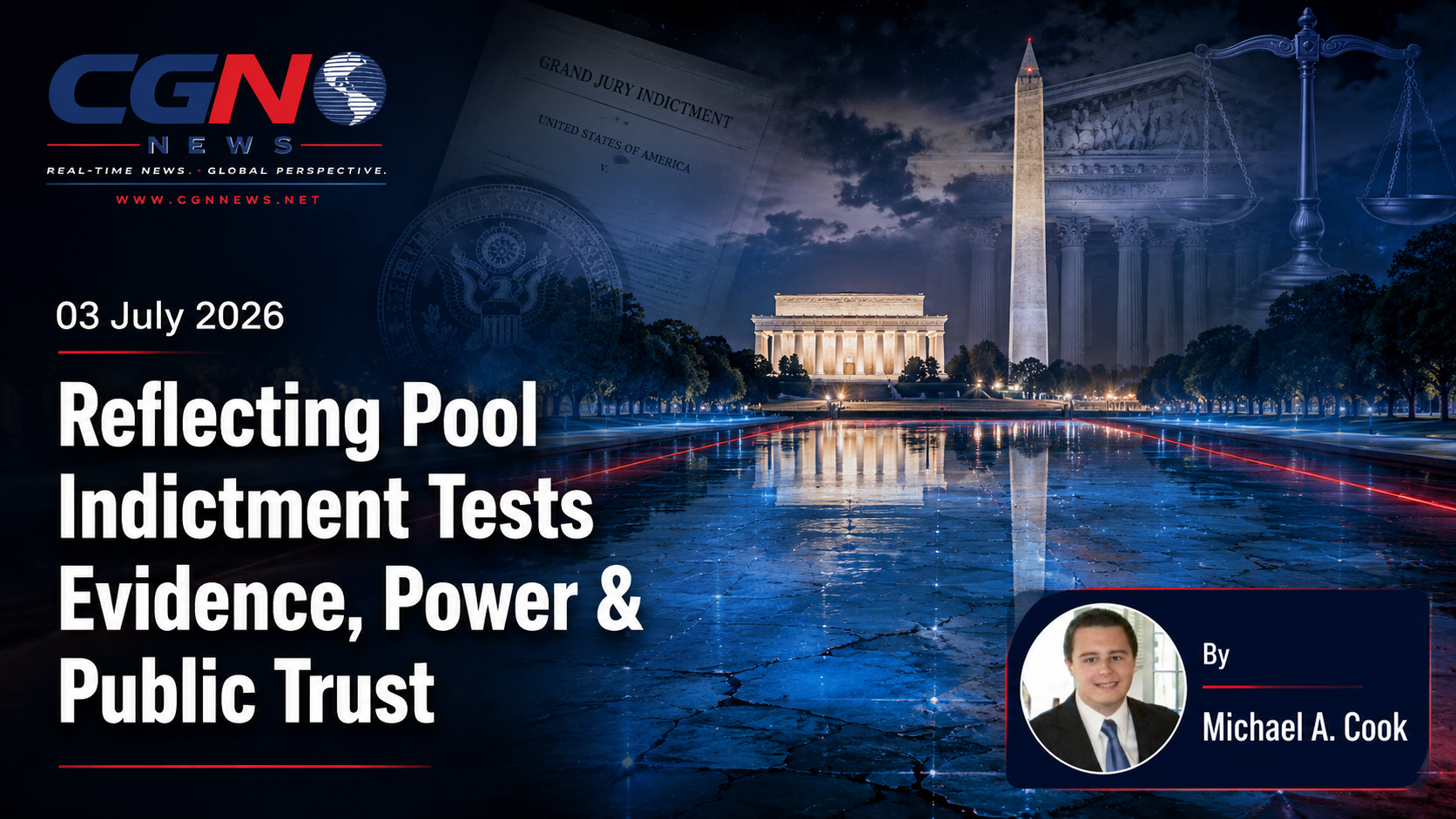
WASHINGTON | The indictment of former U.S. Olympian David Hearn over alleged damage to the Lincoln Memorial Reflecting Pool is now more than a question about a strip of blue sealant at the bottom of one of the most recognizable pools in America.
It's a test of how carefully the government, the press, and the public can handle the case amidst the political climate in Washington.
CGN News previously reported that Hearn had been indicted over alleged damage to the Lincoln Memorial Reflecting Pool. He denies any wrongdoing.
An indictment is not a conviction. It is a formal charging document returned by a grand jury. The burden remains on the government to prove its case beyond a reasonable doubt. Hearn is presumed innocent until proven guilty in a court of law.
The U.S. Attorney’s Office for the District of Columbia announced Thursday that Hearn, 67, of Bethesda, Maryland, had been indicted on one count of felony destruction of property in connection with an alleged June 19 incident at the Reflecting Pool. The office said the case is being investigated by the U.S. Park Police and that a court hearing is scheduled for July 9.
What prosecutors allege
The Justice Department announcement says a grand jury in Superior Court returned the indictment on July 2, charging Hearn with felony destruction of property under D.C. law. Prosecutors say the indictment stems from a June 19 incident in which Hearn allegedly ripped a piece of recently installed blue sealant on the bottom of the Reflecting Pool at the Lincoln Memorial.
Reuters reported that court records described the charge as involving alleged damage worth more than $1,000, a threshold that matters because it can elevate the charge to a felony. ABC News reported that Hearn was accused of “maliciously” destroying lining material at the pool. AP also reported the indictment and framed the case within the broader political dispute over President Donald Trump’s renovation push at the National Mall.
The government’s theory, as publicly described so far, is straightforward: prosecutors allege that Hearn damaged part of the new blue lining at the bottom of the pool. The defense position, as reported by ABC News, Reuters and other outlets, is also straightforward: Hearn denies vandalizing the pool and his lawyers dispute the government’s account.
Those two positions now move from the court of public opinion into a court of law. The prosecution will have to present evidence. The defense will have opportunities to challenge that evidence. The court will decide what is admissible, what is not, and what the law requires.
Who David Hearn is
Hearn is not an anonymous defendant; he is a household name, and known to many in the Olympic and canoeing communities. ABC News described him as a three-time U.S. Olympian. Reuters and AP identified him as a former Olympic canoeist.
Why this case became political so quickly
A charge involving a public monument would already carry symbolic weight. This one carries more so because the Reflecting Pool had recently been renovated as part of a highly visible effort tied to the capital’s appearance ahead of major Independence Day events to celebrate the nation’s 250th birthday.
The project drew attention before the indictment because the pool’s new blue appearance, algae problems, and visible damage became part of a politically charged dispute.
President Trump repeatedly blamed vandals for damage to the pool’s new lining and for algae problems in the water. FactCheck.org reviewed those claims and reported that the administration had not provided evidence sufficient to prove the President’s broader statements about the pool’s problems. FactCheck also noted that experts identified multiple possible explanations for peeling, algae and coating problems that did not necessarily involve intentional vandalism.
The Reflecting Pool is not just scenery
The Lincoln Memorial Reflecting Pool is one of the most photographed public spaces in the United States. It sits between the Lincoln Memorial and the World War II Memorial, on the National Mall, in a space managed by the National Park Service.
It is also part of the civic landscape where Americans gather, protest, mourn, celebrate and mark national anniversaries. Public monuments do not belong to any president, any administration, or any a political party. They belong to the public.
The government’s public statement
The U.S. Attorney’s Office framed the indictment as part of a broader effort to protect national spaces. U.S. Attorney Jeanine Ferris Pirro said in a U.S. Justice Department release that renovations ordered by President Trump had been intended to prepare the capital for America’s 250th anniversary, and that deliberate destruction at treasured places sets back public progress and violates the law.
What Hearn’s defense has said
Hearn denies vandalizing the pool. ABC News previously reported that Hearn said he did not remove, rip, tear, break, destroy or harm the Reflecting Pool. Reuters reported that Hearn’s lawyers have argued he was being used to deflect attention from problems with the renovation.
For now, both sides are speaking into a public space already shaped by politics. The courtroom will require more than rhetoric.
The renovation questions are not going away
Separate from the indictment, the Reflecting Pool project has raised questions about timing, materials and oversight. FactCheck.org reported that the Interior Department awarded a no-bid contract on April 3 to Atlantic Industrial Coatings and that supplemental agreements through June 15 brought the total to $14.7 million. FactCheck also reported that the new lining involved an epoxy primer and polyurea lining tinted blue, and that problems with peeling and algae were reported after the pool was refilled.
Some of those issues may not be relevant to Hearn’s criminal case, but the renovation context matters to public trust. If the pool was already showing signs of failure, peeling or algae growth before the alleged conduct at issue, the government’s broader statements about vandalism deserve careful scrutiny.
The case prosecutor's have may ultimately be razor thin. It may turn on a few minutes of alleged conduct, the condition of the liner, and whether prosecutors can prove intent to damage. But it is more likely to become a larger public discourse over politics and public accountability.
Additional Reporting By: CGN News / Natalie Ward; U.S. Attorney’s Office for the District of Columbia / Department of Justice; Reuters; ABC News; NPR; The Associated Press; FactCheck.org / Kate Yandell; National Park Service / Lincoln Memorial